So, you have decided to take some time out and decode the enigma called GMAT Sentence Correction! Welcome 🙂
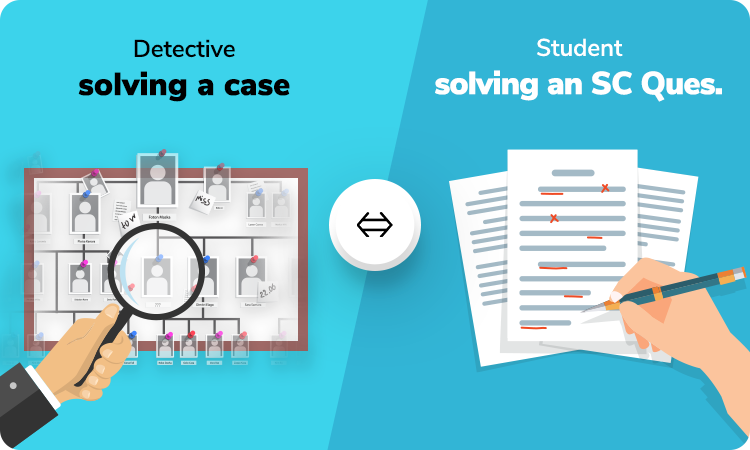
At its core, GMAT Sentence Correction (GMAT SC) requires you to put on your “detective hat”. Just as detectives solve their cases by making intricate logical connections between different pieces of evidence, visualizing the crime, and using their subject matter knowledge, so do test takers an SC question by making logical connections between different parts of a sentence, visualizing the meaning, and using their knowledge of standard English.
As per the Official Guide, the GMAT SC tests our language proficiency in the following ways:
- Correct expression: A correct sentence needs to be grammatically and structurally sound.
- Effective expression: An effective sentence expresses an idea or a relationship clearly and concisely.
- Proper diction: An effective sentence also has the right choice and use of words.
What’s more? SC accounts for almost one-third of your verbal score. So, if you have that target score of 700+, you can do anything but take this sub-section lightly!
Intrigued much? This is just the beginning. Read on as we decipher what the GMAT SC is all about. In this article, we shall discuss the basics of Sentence correction- what it really is, what it tests and what it doesn’t, and why does it test what it tests.
OUTLINE OF THE ARTICLE:
Here is the outline of this article:
- Will reading this article make a difference?
- Structure of an SC question
- Types of errors – What GMAT SC tests
- What the GMAT SC does not test
- Why the GMAT tests SC
- Conclusion
1. WILL READING THIS ARTICLE MAKE A DIFFERENCE?
Why should you trust us or anything we say? Well, for the simple reason that we have delivered more success than any of our competitors. We have 1800 5-star reviews on the GMAT club, which is the well-known online community for GMAT aspirants. We are leaps and bounds ahead of our closest competitor, who has only 600 5-star reviews on the GMAT Club. We also have the highest number of success story interviews on YouTube. This bears witness to the fact that our methods have indeed come a long way in helping our students achieve a high GMAT score.
Our flagship SC course has helped students hit their target scores, no matter what their starting ability was. For example, Ram got a 730 on the GMAT in his very first attempt and aced the SC section by using the meaning-based approach. Aayush was able to score a whopping 750 in his 3rd attempt by using a structured approach to solving SC questions, rather than relying on his ‘ear and gut instincts’ as he did in his first two attempts, before going through the e-GMAT course.
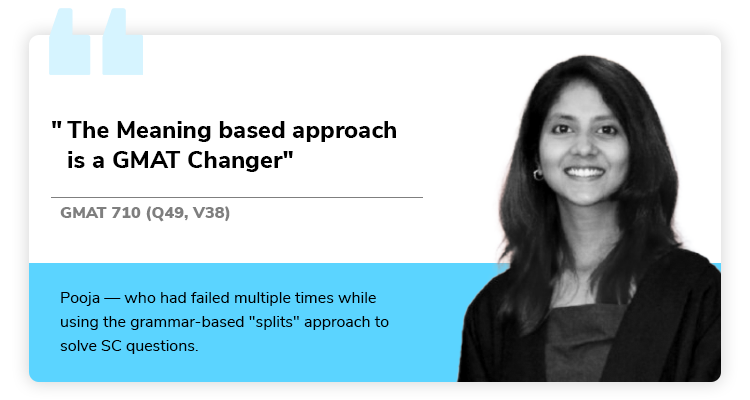
Our students vouch for our unique Meaning-based Approach to SC! Hear from our students Pooja, Aayush, and Vaik how it helped them ace SC. What is even more interesting is how this approach works wonders for non-native speakers. Rohan overcame his weakness in English by learning and applying the e-GMAT approach and scored a 750!
2. STRUCTURE OF AN SC QUESTION
Let us start with the most basic of basic questions. What does an SC question look like?
Here is a sample of an SC question from the Official guide:
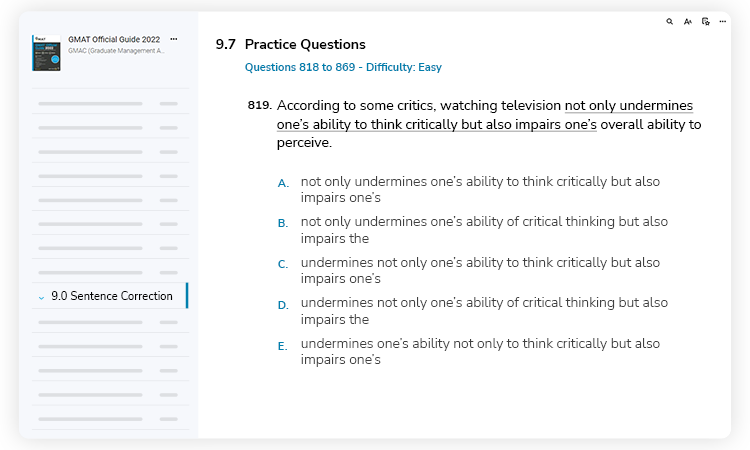
Every SC question consists of two components: A sentence, part or all of which is underlined and five answer choices, each a way of phrasing the underlined portion.
The underlined portion of the sentence may contain grammatical and logical errors, which we will discuss in section 3. Answer choice A is a repetition of the original underlined portion. The other four answer choices are each a different phrasing of the original underlined portion.
Your job is pretty simple: pick the alternative that best expresses the author’s intent and that is clear, exact, and free of errors. It must also minimize awkwardness, ambiguity, and redundancy. Select answer choice A if the original sentence is correct as is. If not, select the most pertinent answer choice among B, C, D, and E. Remember, there is only one correct choice for each question.
700 scorer’s strategy: Though you must rectify only the underlined portion of the sentence, do not forget about the non-underlined portion! Ensure that you pay close attention to how the underlined portion connects to the other parts of the sentence.
Bonus: Do not read option A while going through the answer choices as you have already read the underlined portion of the original sentence. This will save you quite a bit of time in the test environment.
At this point, if you are itching to try your hand at a few fascinating SC questions, we have got you covered! Our free trial contains a good collection of SC questions for your practice.

3. TYPES OF ERRORS
As explained in the previous section, every SC question on the GMAT tests your ability to evaluate a given sentence for any grammatical and meaning errors and to resolve them, if any.
The practice of assigning each error you encounter in GMAT SC to a specific type during your preparation helps you big time in identifying errors quickly when the clock is ticking against you during the exam.
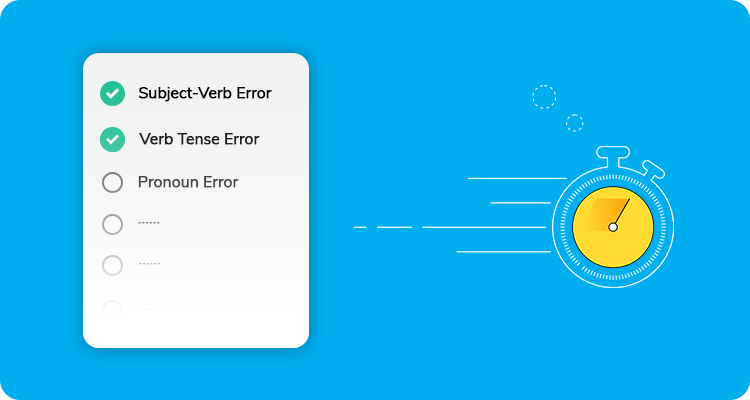
We at e-GMAT have done our homework and have simplified and compartmentalised the various errors you encounter in GMAT SC so that you don’t have to lose sleep over it.
Fun fact: Most sentences in SC have 2-3 different types of errors in them. You will occasionally find a sentence which has no error in it, but in such situations the answer choices introduce 2 to 3 errors of their own. There are very few SC questions that have only one error in them.
Here are the error categories we encounter in GMAT SC:
3.1 Subject-Verb Error
Before we get into the errors pertaining to subjects and verbs, let us first understand what a subject and a verb is. Consider this sentence:
- Jack runs on the beach.
The above sentence is about “Jack.” Therefore, he is the main topic of the sentence and the doer of the action that follows. He is the “subject” of the sentence.
The action that the subject Jack does is “runs.” Therefore, “runs” is the verb in this sentence.
There can be multiple subjects and multiple verbs in a sentence. The important point to note is that every subject must be associated with a verb and vice versa. Otherwise, the sentence won’t make sense. Also, a singular subject must be associated with a singular verb and a plural subject must be associated with a plural verb.
Now that we are clear about what the subjects and the verbs are, let us jump right into the errors related to Subject and Verbs:
Subject-verb must make sense:
Consider this sentence:
- The manufacturer guarantees that the silky red dress with a silver buckle will not corrode.
Something seems off in the above sentence. The author intends to say that the silver buckle will not corrode, but the way the sentence is written, it conveys the meaning that the silky red dress will not corrode, This does not make sense because a dress cannot corrode! We can correct this sentence by rewording it as follows:
The manufacturer guarantees that the silver buckle on the silky red dress will not corrode.
Subject-Verb must agree in number:
Now consider this sentence:
- The current costs has created a good opportunity.
Again, the above sentence is incorrect. The subject of the sentence, the plural noun “costs”, uses a singular verb or action “has created.” Therefore, the subject and the verb do not agree in number.
So, there you go: the subject and the verb must make sense and they must agree in number. Any sentence in the SC section that violates these conventions will fall under the category of Subject Verb error.

700 scorer’s strategy: The subjects and verbs are the backbones upon which the entire sentence relies. If you are just starting out with your SC journey, we strongly suggest that you first master the skill of identifying subjects and their corresponding verbs. Doing so will take you a long way in your SC journey.
3.2 Verb Tense Error
This type of error has got everything to do with the three main time frames in the English language: the past, the present and the future, and their sub –tenses a.k.a. “aspects”. Simple right?
Now mix these tenses up in a sentence and add a pinch of Conditionals and top the whole thing up with a bit of Subjunctives, and you have got yourself a sentence horrifying enough to keep you awake at night, right?
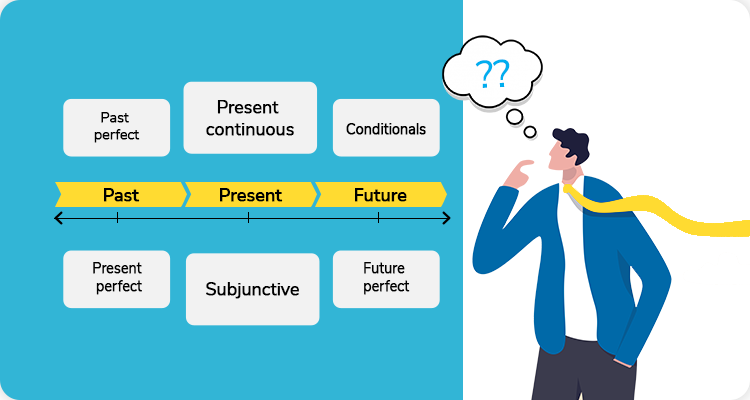
Well, not quite. That would happen only if you do not get the basics right. So, let’s start with that.
The underlying principle behind identifying any verb-tense error is to be crystal clear about the time frame in which each and every event in the sentence occurs. This is where you should put on your logical thinking hats.
Let us see this in action with a simple example:
- Amy had gone to sleep when the phone rang.
This sentence conveys the meaning that by the time the phone rang, Amy had already gone to sleep.
Now consider this slight tweak in the sentence:
- Amy went to sleep when the phone rang.
This sentence coveys the meaning that Amy went to slept at the exact time the phone rang.
Notice how a change in the time frame of Amy’s sleeping changes the entire meaning of the sentence. Identifying this difference is critical while solving SC questions.
Now let us crank it up a notch and bring in the concept of conditionals. A conditional sentence takes application of tenses to a whole different level. It introduces us to the world of real and unreal ideas through various constructions, such as if-then, would, etc. For example:
A. If I went to work, I took my phone with me.
B. If I went to work, I wouldn’t have an office at home.
Sentence A conveys a past truth, whereas sentence B conveys a hypothetical idea in the present. The first tells us something I always did whenever I went to work. But the second implies that I don’t go to work. That’s why I have an office at home. If I went to work, I wouldn’t have an office at home.
Next, we have the moods of verbs, a less-known concept of grammar. Moods of verbs indicate how the overall sentence is viewed or perceived. GMAT SC’s favourite mood is the Subjunctive, the mood that is used to convey hypothetical ideas. A common usage of the subjunctive is in sentences that convey suggestions, recommendations, or advice against things being practised. For example,
- The Supreme Court ordered that sale and consumption of alcohol be banned across the country.
Notice how the sentence above uses the subjunctive form ‘be’ and not ‘is’ or even ‘should be’ to convey something that should be brought into practice throughout the country.
We have just scratched the surface here! Obviously, there are different levels to any skill. No matter whether you are dealing with conditionals, subjunctives, or plain and simple tenses, if you want to do well in SC, you must be able to identify the time frame of every event and the impact of change in tense on the meaning of the sentence.
700 scorer’s strategy: Ensure that you cover the three main tenses in the English language along with the concepts of conditional constructions and subjunctives to master the verb tense errors on the GMAT.
3.3 Pronoun-Antecedent Agreement Error
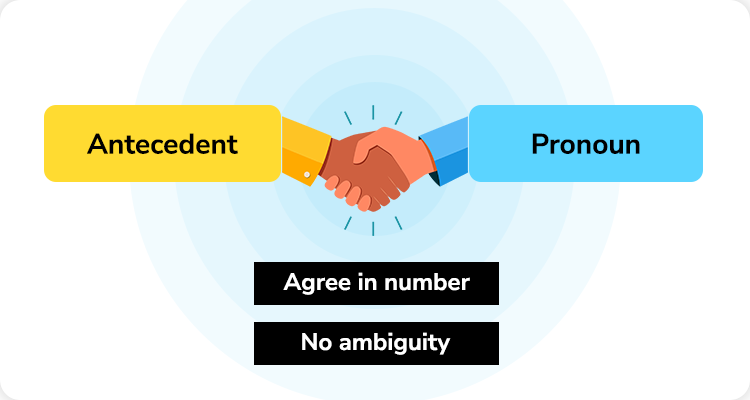
A pronoun, which acts as a substitute for another noun entity in the sentence, must agree with that noun entity (also called the antecedent of the pronoun): it must have the same number, be of the same gender and person, and match the role it plays in the sentence. For example, consider this sentence from the Official guide:
- John loves exercising, so they go to the gym daily.
In the above sentence, the plural pronoun “they” refers to the singular noun “John”. Therefore, there is a pronoun-antecedent number agreement error. We must use the singular pronoun “he” so that the pronoun agrees with the noun “John” in gender, number, person, and function.
Additionally, there should be no scope for ambiguity with regards to the antecedent of a pronoun. A pronoun must clearly and unambiguously refer to its antecedent. For example, consider this Official sentence:
- The Eastern State Penitentiary was established in 1822 by reformers advocating that prisoners be held in solitary confinement and hard labor so as to reform them.
Here, the reference of the pronoun “them” is ambiguous. It could refer to “reformers,” “prisoners,” or even “solitary confinement and hard labor!” The sentence can be corrected as follows:
The Eastern State Penitentiary was established in 1822 by reformers advocating solitary confinement and hard labor as the means to reform prisoners.
700 scorer’s strategy: It is not necessary that an antecedent always appear before a pronoun. The antecedent of a pronoun can appear much later in the sentence. For example:
- Although it is a big firm, ABC Corporation rarely recruits from top colleges.
Here, the pronoun “it” appears before the antecedent “ABC Corporation.”
3.4 Modifier Error
The Modifier Error is the king of all the error types tested in GMAT SC! This is the error type dreaded by most students, but there is no escape from it because it is also one of the most frequently tested error types in GMAT SC.
A Modifier is a word or a group of words that gives additional information about another word, group of words, or a sentence. More often than not, the errors belonging to this category are “misplaced modifier” errors. What this means is that the modifier is placed incorrectly in the sentence such that it doesn’t modify the intended entity. All you must do is move the modifier to the correct position et voila! you have corrected the modifier error (along with a bit of other possible minor tinkering of course!)
Here is a demonstration of how to correct the misplaced modifier error in the given Official question:
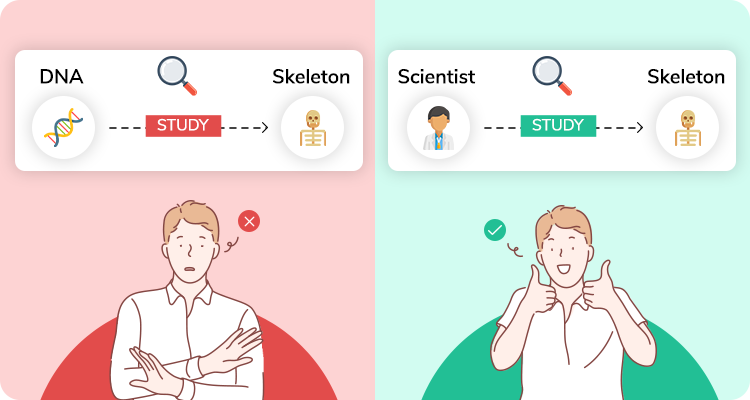
- Studying skeletons unearthed near Rome, DNA evidence was recovered by scientists, who were able to deduce from this that an epidemic of malaria struck in the empire’s waning days.
In this sentence, the modifier “studying skeletons near Rome” incorrectly modifies “DNA evidence.” How can DNA evidence study the skeletons? Logically, the given modifier must modify “scientists.” This error can be corrected as follows:
Scientists studying skeletons unearthed near Rome recovered DNA evidence from which they were able to deduce that an epidemic of malaria struck in the empire’s waning days.
Another modifier error tested in SC is the dangling modifier error. This error is exactly what the word “dangling” means. The modifier just dangles in the sentence without referring to anything in the sentence. Consider this official question for example:
- Without adequate amounts of sleep, people’s newly acquired skills and also new factual information may not get properly encoded into their memory circuits.
The modifier “without adequate amounts of sleep” does not point to anything in this sentence. Logically, it must modify “people”, but the word “people” is not present in the sentence. All we have in the sentence is “people’s skills”. Therefore, the given modifier is dangling. We can correct this error as follows:
If people do not get adequate amounts of sleep, newly acquired skills and even new factual information may not get properly encoded into their memory circuits.
Point to note: Modifiers is a vast topic on the GMAT SC, and you might get confused what to study and what not to study. To make your life easier, here is a list of the type of modifiers you should definitely cover:
- Adjectives,
- Adverbs,
- verb-ing modifiers (modifying nouns and actions),
- verb-ed modifiers (modifying nouns and actions),
- relative pronoun modifiers, and
- noun+noun modifiers.
3.5 Parallelism Error
The entities that perform the same function in a sentence must be parallel. Entities in a list are, hence, parallel entities. A sentence often contains a list of various elements such as words, phrases, or clauses. These elements must be consistent or “parallel” with one another in terms of logic and grammar. That is what the concept of parallelism entails. The test makers introduce parallelism errors in the sentence by making one or more elements of the list inconsistent in terms of logic and grammar.
Here is a small exercise for you. Solve this question from the Official guide that tests parallelism:
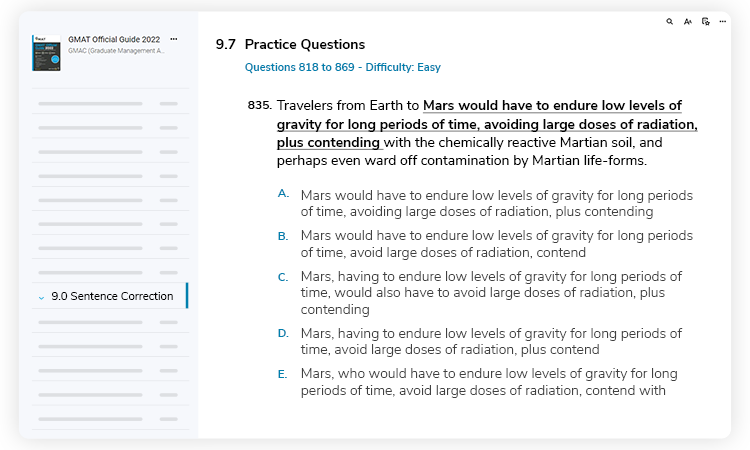
The correct answer for this question is option B. Kudos to you if you got it right! But do not fret if you did not. This is just the beginning of your SC journey. Let us see how to go about solving this question.
The meaning of the sentence is quite clear: travellers from Earth to Mars would have to do four different things. However, the two of the actions mentioned (avoid large doses of radiation and contend with chemically reactive Martian soil) are not consistent with the other two in the original sentence. Therefore, the sentence has a parallelism error. We can correct this error by making all the four entities parallel as done in the correct answer choice B.
700 scorer’s strategy: Watch out for words such as and, either/or, not only/but also, but, etc. They indicate the presence of parallelism
3.6 Comparison Error
A sentence may contain a comparison or contrast between two or more elements. Comparison is in a way is also a test of parallelism because the elements being compared must be grammatically and logically parallel to one another. For starters, the test makers introduce comparison errors by making an illogical comparison. The popular saying “apples and oranges” applies perfectly here.
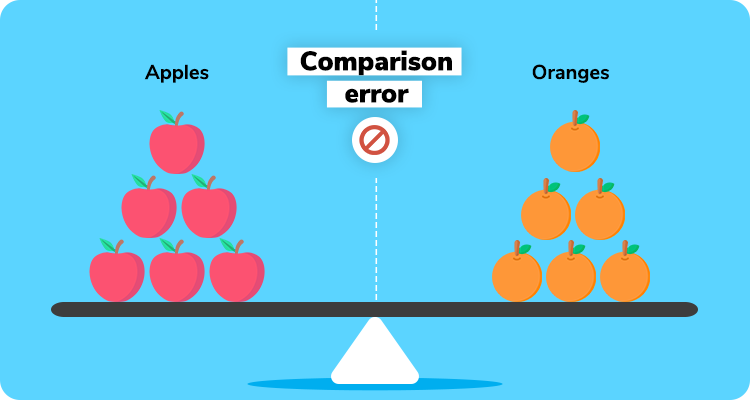
Here is a classic official example of the same:
- Unlike the virginal, whose single set of strings runs parallel to the front edge of the instrument, the harpsichord’s several sets of strings are placed at right angles to its front edge.
Even though the sentence intends to present contrast between the two instruments, virginal and harpsichord, the sentence is written in such a way that it presents an illogical comparison between the virginal and the sets of strings of the harpsichord. We can correct this sentence by presenting a contrast between the two instruments as follows:
- Unlike the virginal, which has a single set of strings that run parallel to the front edge of the instrument, the harpsichord has several sets of strings placed at right angles to its front edge.
Moving further, the test makers could even present you with a case of ambiguous comparison. For instance,
- Joe likes the pizza more than John.
The above sentence is ambiguous: Does Joe like the pizza more than he likes John? Or does Joe like the pizza more than John likes the pizza?
We can eliminate the ambiguity by re-phrasing the sentence in the following ways:
- Joe likes the pizza more than John does.
- Joe likes the pizza more than he likes John.
Bingo! We have corrected the comparison error! Both the sentences above present valid comparisons respectively, even though the first is more likely the intended meaning. Under normal circumstances and unless specified explicitly, a person wouldn’t like a pizza more than another person. The GMAT expects you to bring this understanding to the table.
700 scorer’s strategy: Be on the lookout for words such as like, as, than, compared to, different from, etc. They indicate the presence of comparison in a sentence.
3.7 Idiomatic Error
Here is a small exercise for you:
Identify the sentences that are incorrect:
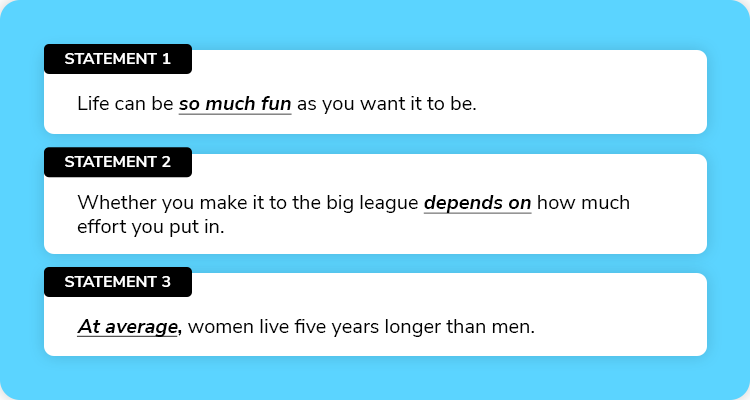
Only sentence 2 above is correct. Both sentences 1 and 3 are wrong. It is incorrect to say “so much fun as” in sentence 1. The correct expression is “as much fun as.” Similarly, it is incorrect to say “At average” in sentence 3. The correct expression is “On average.”
But this is where it gets interesting: Can you think of any earthly reason why the expressions written in boldface in sentences 1 and 3 are wrong?
I bet my bottom dollar that you cannot! That is because this is simply how we do things in English. Such expressions, which consist of ordinary words but whose meaning cannot be inferred from the meanings of their component parts, are called idioms. It is important to be aware of these standard expressions to communicate effectively in English. Therefore, such expressions are tested on the GMAT SC The test makers introduce an idiomatic error by replacing one of the component words – usually a preposition – of standard expressions with an incorrect one; and you are often expected to identify such errors in answer choices that are otherwise free of grammatical errors, making such questions even more difficult to solve.
700 scorer’s strategy: The idioms in the English language are so numerous that it is impossible to list them all. So don’t even try! The best way to learn idioms is by reading and practicing.That being said, ensure that you cover the frequently tested idioms on the GMAT during your preparation. These include:
- idioms related to as, so, and, or/nor, not
- idioms related to quantities
- usage of due to vs because of
- Idioms of comparison
3.8 Meaning Error
A perfect sentence is the one which communicates a clear meaning in the most succinct and direct way and is clear of any grammatical errors. Meaning errors are introduced in a sentence by using wrong words, making the sentence awkward, or presenting an ambiguous meaning.
The right usage of words, or Diction, is very important to communicate the right meaning. Diction errors are introduced in a sentence by using the incorrect part of speech, the wrong quantifying words, incorrect prepositions, etc. For example, consider these two sentences:
- Currently, builders do not have many incentive to build huge mansions.
- I was ease able to figure out the solution to the given problem.
Both the above sentences are incorrect. In the first sentence, the uncountable noun ‘incentive’ has been modified by ‘many’ instead of ‘much’, whereas in the second sentence, the verb ‘was able’ has been modified by the adjective ‘ease’ instead of the adverb ‘easily’.
Rhetoric is the art of using language in speech or writing in a special way that facilitates comprehension and even influences people. When the GMAT says that it tests us on Rhetorical Construction, it refers to eloquence. A sentence could be grammatically, idiomatically, and even logically sound, but still be vague and awkward. Take a look at the following examples taken from the Official Guide:
- Expectedly, the goodness of her doing the job was considerable.
- Her hope was for other solar systems’ planets’ possible human exploration.
The above sentences are technically correct, but they’re immensely confusing. This is how we put them rhetorically, respectively:
- As expected, she did the job very well.
- She hoped that humans would be able to explore some of the planets in other solar systems.
Finally, in GMAT SC, you will sometimes find a sentence whose meaning is ambiguous. The best way to go about this type of error is to infer all the possible logical meanings from the context and select the option that conveys one of the possible meanings clearly and unambiguously.
700 scorer’s strategy: Some people fall into the trap that a shorter answer choice is a safer bet than a longer choice. Such guesses can be dangerous and unwarranted. Always eliminate an answer choice for the right reasons.
3.9 Other Errors
We have covered the majority of the errors that you would encounter in SC in the above nine categories. However, there are few additional types of errors you must be aware of, such as sentence fragments, punctuation and linkage errors, and run on sentences.
Sentence fragments, as the term indicates, are parts of a sentence that do not function as intended because of a missing verb or a missing subject. Consider this official sentence for example:
- The foundation works to strengthen local and regional agricultural markets and cooperating with governments to improve access for farmers to productive resources such as land and credit.
The intended meaning of the sentence is that the foundation does two things: works to strengthen markets and cooperates with the governments. However, the portion in the boldface is a sentence fragment and has a missing verb. We can correct this error by converting the word “cooperating” to the verb “cooperates”.
Punctuation and linkage errors occur when the elements present in a list are not connected properly or when the different parts of a sentence are connected incorrectly. For example, here’s an official sentence with a punctuation error in it. Can you spot it?
- As a baby emerges from the darkness of the womb, its rudimentary sense of vision would be rated about 20/500; qualifying it to be legally blind if an adult.
This is a classic case of the incorrect use of a semi-colon! We need to use a comma instead of a semicolon in the above sentence.
A run on sentence occurs when two complete sentences (A complete sentence is the one which has at least one subject-verb pair) are connected without proper punctuation or connecting words. For example:
- The task was challenging, the reward was worth it.
Two sentences are improperly connected using just a comma. We must use a proper connecting word such as “but” along with the comma to connect the two sentences.
Here is a quick summary of all the errors for your reference:
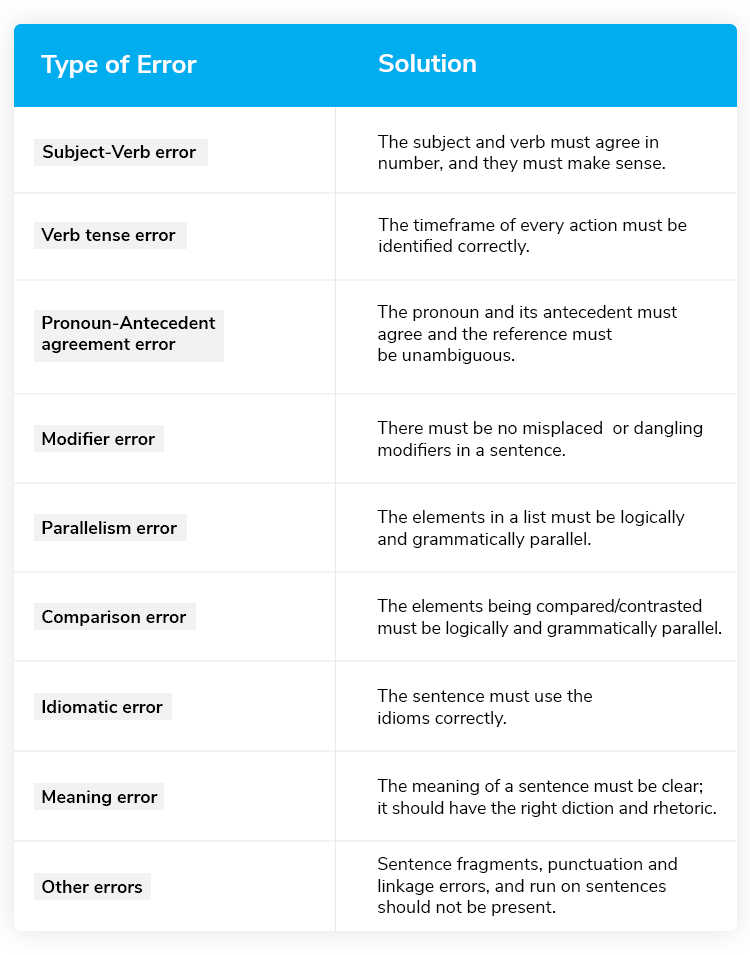
So, there you go! The above are all the different error types that you will encounter in GMAT SC. We at e-GMAT have designed our course modules in such a way that we systematically teach the concepts related to each error type, one module after the other in the same order as explained above. You can check this out in our free trial!
4. WHAT THE GMAT SC DOES NOT TEST
The English language is very vast, and it gets even more complicated when we add the nuances of local variations in the language and ever-evolving technical jargon. It is impossible to learn anything and everything under the sun! Thankfully, the GMAT has set boundaries, within which it tests one’s ability. Here are the things that are NOT tested on GMAT SC, as per the Official guide:
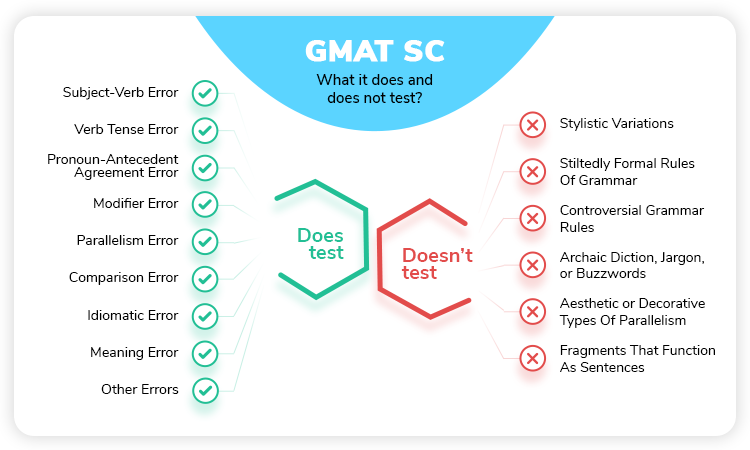
4.1 Stylistic Variations
You are not expected to choose between different forms of words that have the same function and meaning. For example: While/Whilst, until/till etc. You are also not expected to judge conventions of punctuation that vary from region to region or are matters of pure style. For example, according to the OG, you will not be asked to judge whether a comma should be placed inside or outside a closing quotation mark, whether emphasis should be indicated by italics or whether an apostrophe should be inserted before the “s” in a non-plural word (ABCs vs. ABC’s).
4.2 Stiltedly Formal Rules Of Grammar
Some people advise the usage of subject pronouns (I, you, she, he, we etc.) in both the subject and object case with the verb “to be.” For instance, It is I who laughed.
It is me who laughed. According to this rule, the 1st sentence is correct, and the 2nd is incorrect. GMAT SC stays away from such stiltedly formal rules of grammar. You are not expected to eliminate any answer choice based on the above reason.
4.3 Controversial Grammar Rules
GMAT SC stays away from controversial grammatical rules such as usage of which vs that in restrictive contexts (Restrictive contexts in very simple terms, are when commas do NOT appear before the that/which modifiers). As far as the GMAT is concerned, both the below sentences given in the Official guide are correct:
- Laws which have been repealed are no longer enforced.
- Laws that have been repealed are no longer enforced.
Another example is of the split infinitive. Infinitives, or to-verb phrases, are phrases beginning with ‘to’ followed by a verb in its first form. For example: to eat, to sleep, etc. Some people object to placing an adverb between “to” and ‘the verb’. For example:
- To finally bake the cake.
Here, finally is placed inside the to-verb phrase “to bake.”
You should not expect to see SC questions for which the deciding factor is whether the writer adheres to the above objection.
4.4 Archaic Diction, Jargon, or Buzzwords
Archaic words such as “thou,” “shalt,” “maketh” sound great in a Shakespearean play, but you are not expected to correct such words or understand that they can be paraphrased as something else. For example, as given in the Official guide, you are not expected to know that “skint” can be paraphrased as “lacking resources.”
Additionally, you are not expected to know highly specialized technical jargon, buzzwords, and obsolete forms of idiomatic expression. You will also not be expected to know whether a highly specialised term, say FMCG (Fast moving consumer goods), takes a plural or a singular verb.
4.5 Aesthetic or Decorative Types Of Parallelism
As per the Official guide, “SC questions do not require decisions about aesthetic or decorative types of parallelism. For example, you will not be asked to decide whether a rhymed pair such as “highways and byways” would be preferable to another phrase that is equivalent in meaning and function.”
4.6 Fragments That Function As Sentences
As far as the GMAT is concerned, a group of words must have a subject and a verb to function as a sentence. However, in colloquial English, a group of words that has no subject or a verb sometimes functions as a complete sentence. For example, “No,” “the one on the right,” or exclamations such as “how sweet!” You should not expect to see a GMAT SC question in which the above function as complete sentences.
5. WHY THE GMAT TESTS SENTENCE CORRECTION
Now that we know all about what are tested and are not tested on GMAT SC, let us decode why this section exists in the Verbal Reasoning section in the first place, and why should you give it importance?
How we wish Homo-Sapiens had the superpower of telepathy so no ideas would ever get misinterpreted and no scope for a gap in communication would ever exist. However, in the absence of this fantastical ability, the next best tool at our disposal is language, in particular, the standard written English language. The correct usage of this tool, i.e. to avoid any misquotes and misinterpretations, and the effective usage of this tool, i.e. to express ideas in the best possible manner, are of utmost importance. And that is exactly what the GMAT SC tests.
The correct and effective usage of the English language or any language for that matter requires the awareness of the logical implications of the grammatical forms and elements. Let us see the same in action:
Suppose a person A makes the following statement:
- Flying planes can be dangerous.
This sentence is flawed because it can be interpreted in two different ways:
Person X interprets it as: Planes that are in the air can be dangerous.
Person Y interprets it as: To fly planes can be dangerous
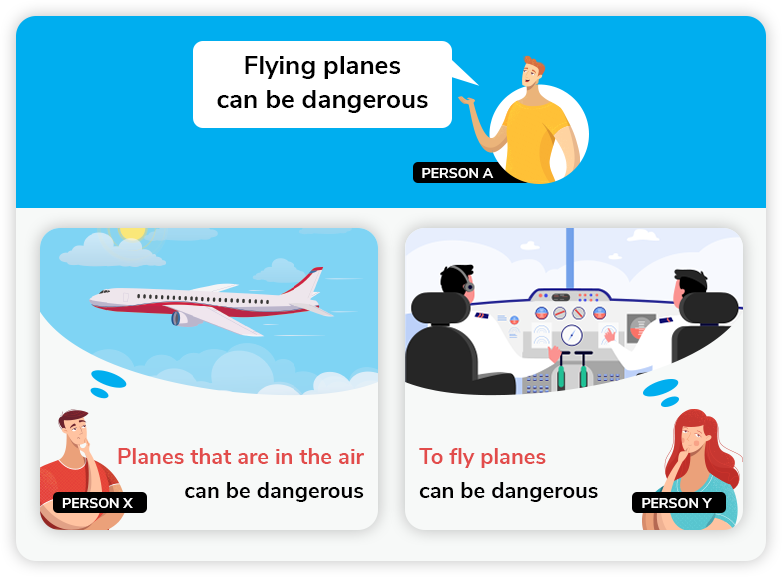
Now imagine that person A uses similar language to communicate something important and persons X and Y take different courses of actions based on their different interpretations! The cost of such ineffective communication would be huge.
This is true especially in government, commerce, education, or any other sector that an aspiring manager aims to get into. Therefore, the GMAT has a good reason to test these skills of prospective managers.
At the same time, it is important to note that grammar is important insofar that it is required to communicate the correct meaning. Beyond that, the GMAT does not want you to be a grammarian!
6. CONCLUSION:
This brings us to the end of this article. Congratulations on taking the first step towards your GMAT Sentence Correction journey! We hope you now have a good idea about what Sentence correction really is, what an SC question looks like, what SC tests, and what it doesn’t.
But this is not all there is to SC. If you want to learn how to ace GMAT SC and what core skills to build to do so, then watch out for our follow up article. In that article, we will cover the 4 core skills required to ace the GMAT SC:
- Understand the sentence structure
- Understand the intended meaning
- Error analysis
- Answer choice analysis
Additionally, if you are someone who has just begun your preparation or you have been preparing for some time but aren’t able to get past the 90th percentile threshold, then watch out for our article on how to study to score 90th percentile on SC. We will cover the best practices and the tools one requires to ace this section. We will also cover what not to do in your SC preparation journey to safeguard yourself from the common pitfalls.