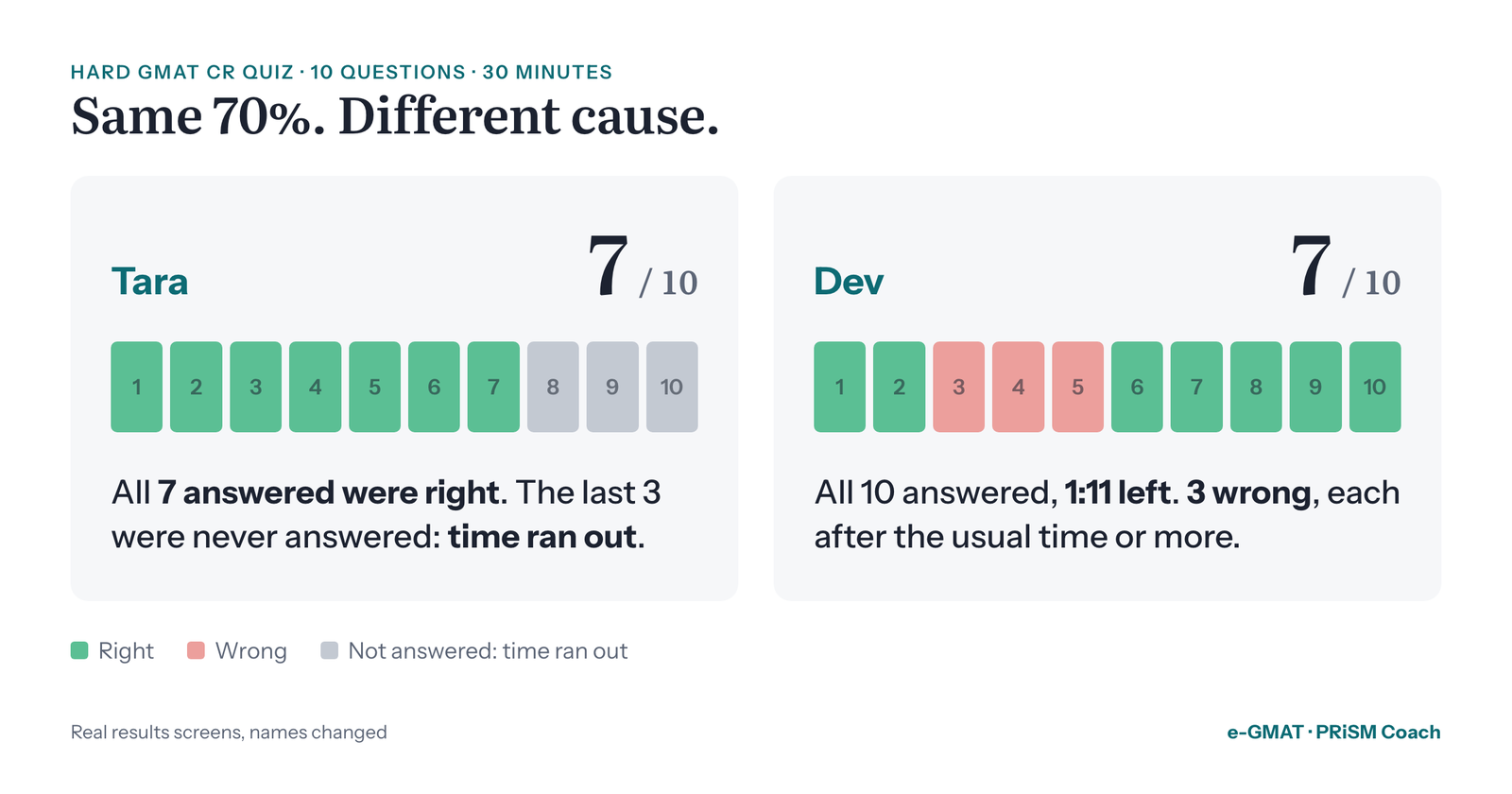
Short answer: A 70% on a hard GMAT Critical Reasoning practice quiz is a strong starting point. For this case study, the next practice target is 80%: on 10 questions, one more right answer. Two e-GMAT students, Tara and Dev, both scored 7 out of 10, for different reasons. Tara got all 7 answered questions right but ran out of time: one very hard question took 3 extra minutes, almost exactly the time deficit flagged at the start of question 6. Dev had time left, but on both Inference questions picked the same kind of wrong answer: a prediction the passage does not support. More CR practice would have fixed neither of them.
You finish a hard Critical Reasoning quiz. 70%. The results screen labels it Strong and shows a 90th-percentile quiz ranking. Most of us would stop right there.
This article shows where the next question is hiding, using the real results screens of two e-GMAT students. Their names are changed.
About the benchmarks: Quiz percentile labels are specific to these practice results. The 80% target here is a coaching target, not a conversion to the 99th percentile on the official GMAT. GMAT scoring also considers question difficulty and other response characteristics. See GMAC’s scoring explanation.
Is 70% on a hard GMAT CR quiz good enough?
It is strong, and 80% is a useful next practice target for this case study. On a 10-question quiz, that is 8 right instead of 7. One more question.
Tara and Dev took the same kind of quiz: 10 hard CR questions in 30 minutes. Both scored 7 out of 10: 70%, with a quiz result labelled 90th percentile and Strong. But they lost their three questions in different ways:
- Tara answered 7 questions and got all 7 right. Every point Tara lost was a question Tara never got to answer.
- Dev answered all 10, with time left. On each of the 3 wrong ones, Dev spent the usual time or more.
Ask them what went wrong, and you get two confident answers.
- Tara: “I ran out of time. I am slow at CR. I need a lot more CR practice.”
- Dev: “I had the time. The three wrong ones were just silly mistakes.”
Both sound sensible. Both are wrong. If Tara and Dev just practice more CR, neither of them will find that eighth question. And for both of them, the trouble was in the same topic, Inference. So should both practice more Inference? We come back to that below.
Why do you run out of time on GMAT CR?
Start with Tara’s question 8. Tara spent 2:09 on it, about the usual time of 2:10. Then the clock ran out before Tara could pick an answer. It was not a very hard question either: about 6 in 10 students get it right. PRiSM Coach, the coach that sits down with every e-GMAT student on the results screen the moment a quiz ends, marks it “No review needed”.
So is Tara slow at CR? Look at the time chart.
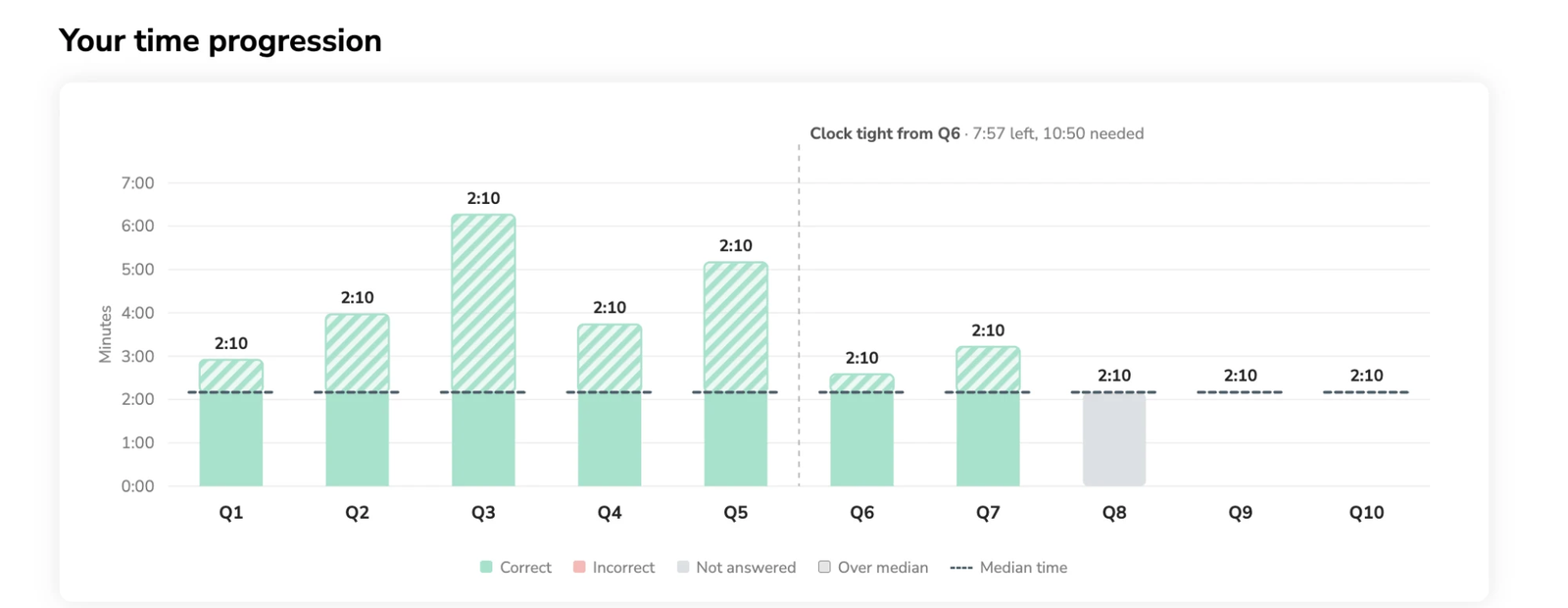
The dashed line on each bar is the usual time for that question, from how long other students take on it. Four of Tara’s bars go far above it:
| Question | Topic | Tara’s time | Over the usual (2:10) | Result |
|---|---|---|---|---|
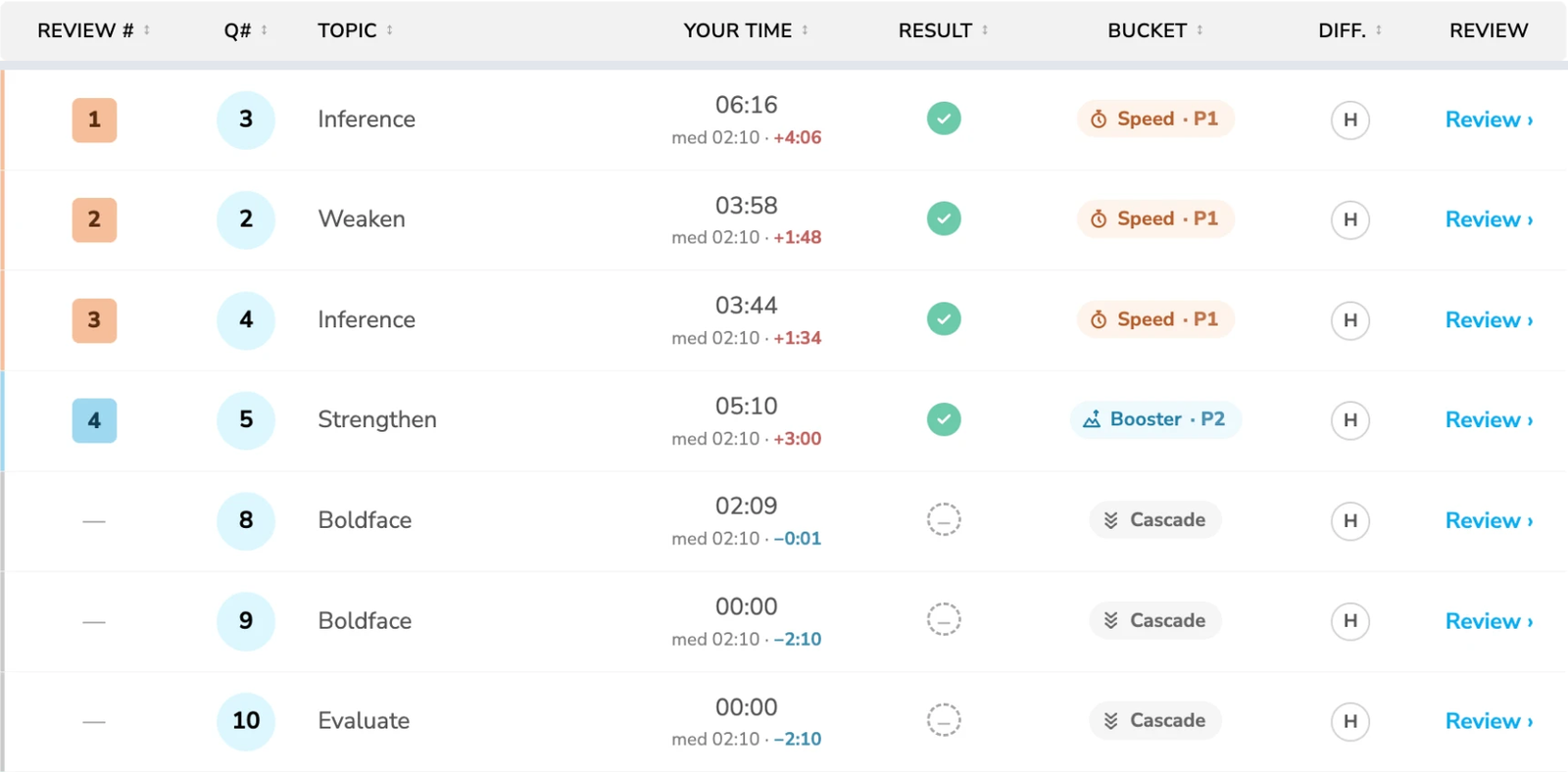
| Q2 | Weaken | 3:58 | +1:48 | Right |
| Q3 | Inference | 6:16 | +4:06 | Right |
| Q4 | Inference | 3:44 | +1:34 | Right |
| Q5 | Strengthen | 5:10 | +3:00 | Right |
| Total | +10:28 |
The note on top of the chart says it plainly: “Clock tight from Q6 · 7:57 left, 10:50 needed.” Tara was short by about 3 minutes.
Now look at question 5. It is a Strengthen question that only about 1 in 4 students gets right. Your PRiSM Coach labels this a score booster: a very hard question, and a bonus when you get it. Tara got it. Well done, Tara. But it took 3:00 more than usual, and the chart flagged a 2:53 deficit at the start of Q6.
| Measure | Time |
|---|---|
| Extra time on Q5 (5:10 taken; 2:10 usual) | 3:00 |
| Deficit at the start of Q6 (7:57 left; 10:50 usual time needed) | 2:53 |
A bonus is worth it only if it does not cost you a question at your own level. Here, the overrun contributed to Tara running out of time before selecting an answer to question 8.
The other three tall bars are right answers too. Your PRiSM Coach calls these speed gaps: right answer, but it took too long. Question 3, an Inference question, took 6:16, almost 3 times the usual time.
Should you review CR questions you got right?
Yes, when they took far longer than they should. Every question on Tara’s review list is a right answer.
“I need a lot more CR practice” is one big, vague problem. And more CR at the same pace gives the same result: 7 answered, 3 blank. PRiSM Coach gives Tara something else: 4 questions to review, in order, each with its own question to ask.
Most CR questions on e-GMAT have a full teaching solution in four parts: passage analysis, logical structure, thinking it through (where you pre-think the answer) and answer choices (where every choice is explained). Tara puts each of Tara’s own steps next to those parts.
- Question 3, Inference (speed gap). Which part took so long? Did I read the passage again and again? Or did I skip the pre-thinking and go back and forth between the choices?
- Questions 2 and 4, Weaken and Inference (speed gaps). The same question. For question 4, one more: is it the same part as in question 3? If it is, that is Tara’s Inference habit.
- Question 5, Strengthen (score booster). What cracked it? And was it worth 3 extra minutes, with 5 questions still to go?
Questions 8, 9 and 10 are cascade questions: rushed or skipped because time ran out. No review needed.
So instead of “a lot more CR practice”, Tara has 4 questions and a clear reason to review each one. “Go faster” is not on the list: when the process gets shorter, the time gets shorter too.
Were Dev’s wrong answers really silly mistakes?
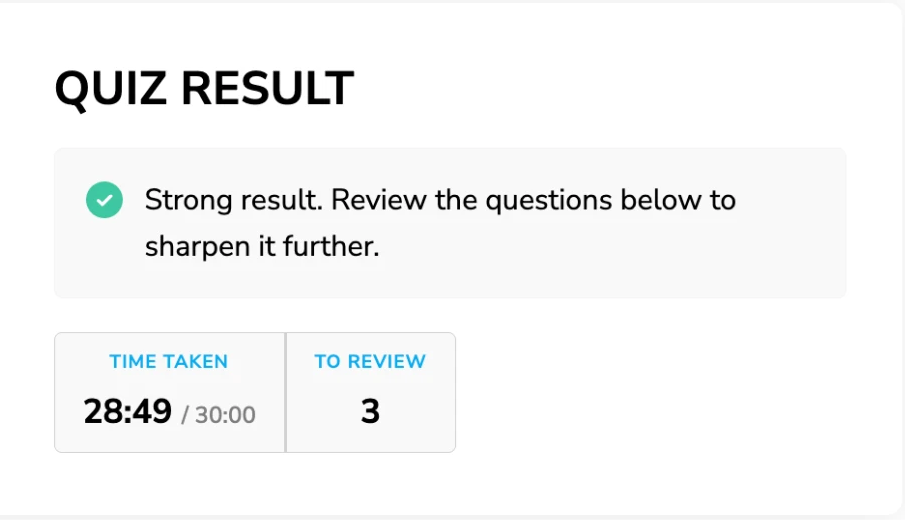
No. Dev’s results tell a different story from Tara’s. Dev used 28:49 of 30:00 and left nothing blank.
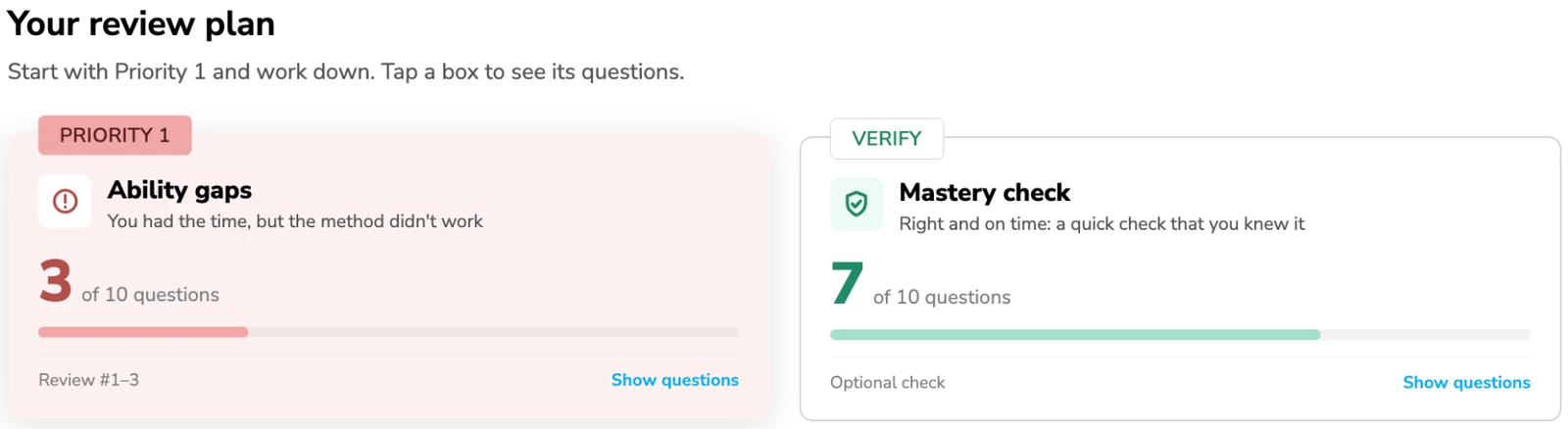
Dev’s review plan has only one box to work on: 3 ability gaps. PRiSM Coach describes them as “You had the time, but the method didn’t work.” The other 7 questions are mastery questions: right and on time.
| Question | Topic | Dev’s time | Usual time | Students who get it right |
|---|---|---|---|---|
| Q4 | Weaken | 4:21 | 2:10 | 46% |
| Q3 | Inference | 2:18 | 2:10 | 41% |
| Q5 | Inference | 2:43 | 2:25 | 38% |
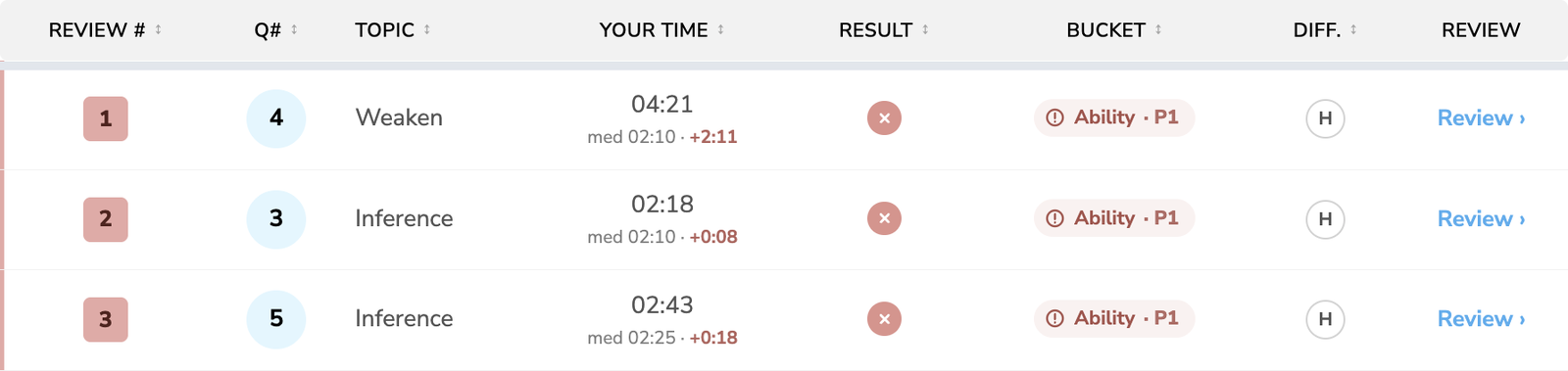
Every one took the usual time or more; question 4 took twice the usual time. If Dev had rushed them, PRiSM Coach would show judgment gaps. There are none. And these are not score boosters, which only about a third of students or fewer get right. They are questions at Dev’s level, and Dev gave each one a full try.
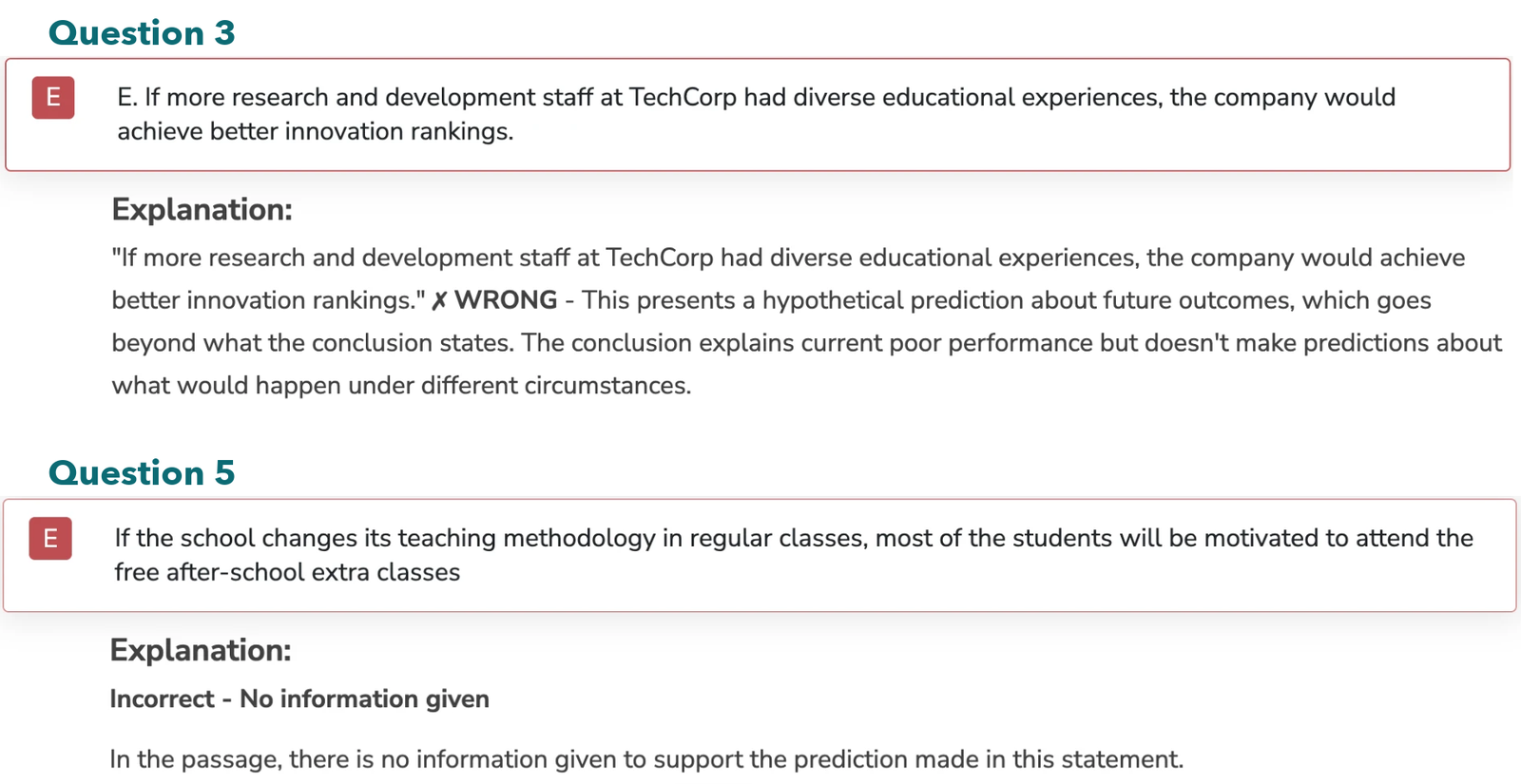
Then look at what Dev picked on the two Inference questions. Both times, choice E. And both times, the same kind of answer:
- Question 3: if the company’s research staff had more diverse educational experiences, the company would rank higher on innovation.
- Question 5: if the school changes its teaching methods, most students will be motivated to come to the extra classes.
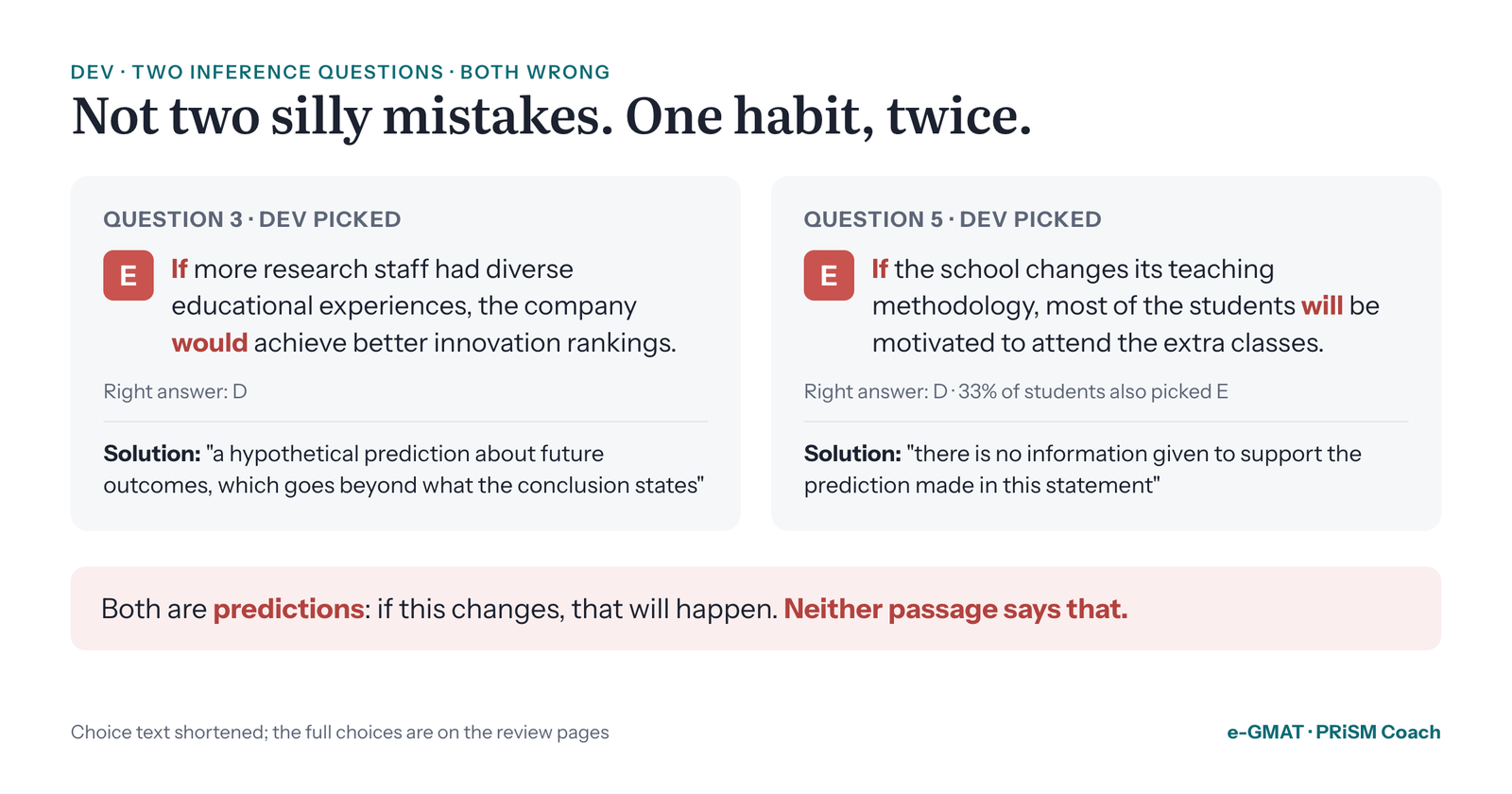
Both are predictions: if this changes, that will happen. Neither passage says that. So these were not two silly mistakes. It is one habit, showing up twice: picking an answer that goes beyond what the passage says. And Dev is not alone: on question 5, 33% of students picked the same choice E.
That is where Dev’s eighth question is. In Inference.
How do you review a wrong CR answer?
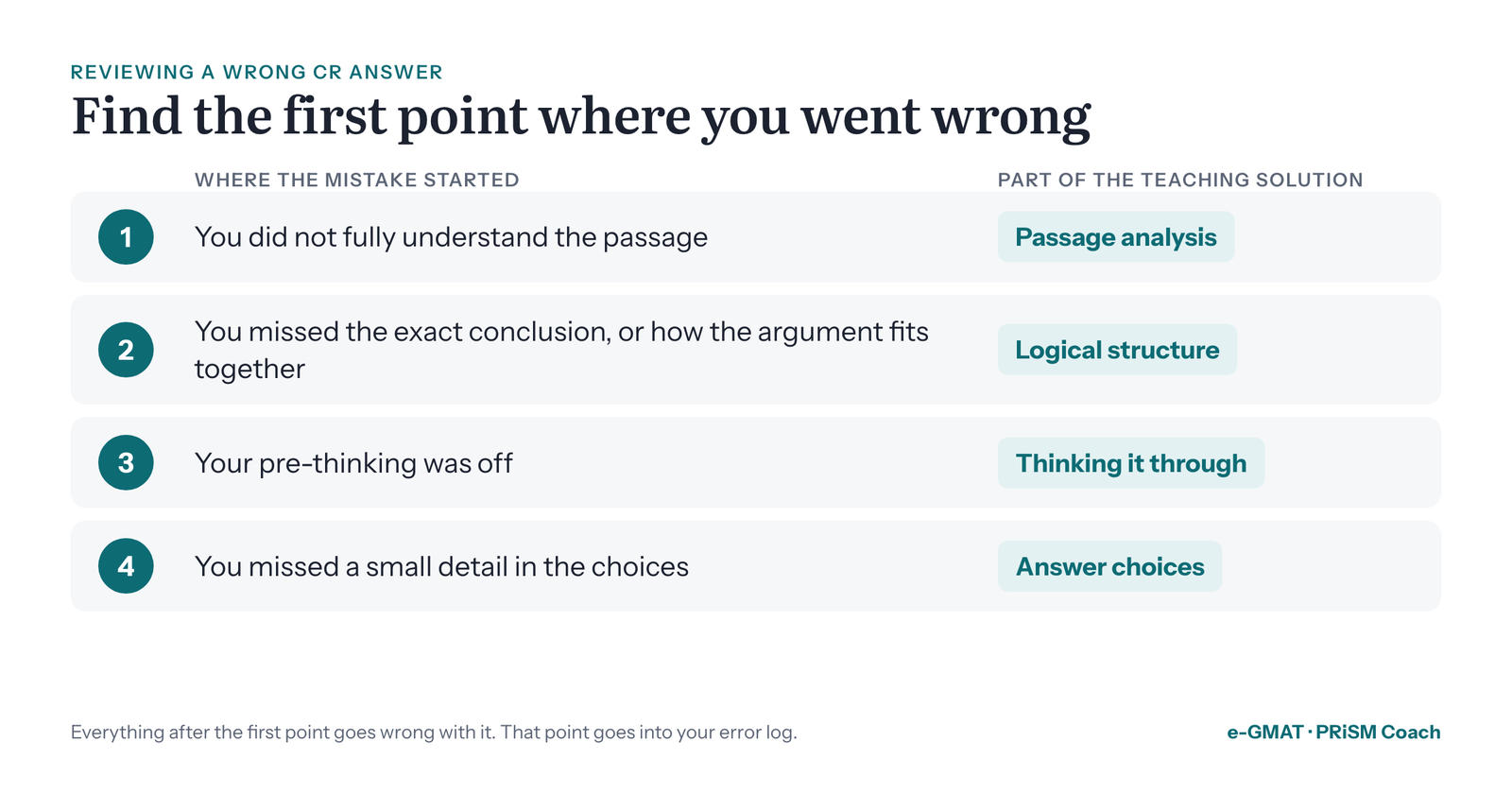
Find the first point of failure: the first step where your thinking split from the solution. In CR, a wrong answer starts at one of four points, and each one matches a part of the teaching solution:
- You did not fully understand the passage (passage analysis).
- You missed the exact conclusion, or how the argument fits together (logical structure).
- Your pre-thinking was off (thinking it through).
- You missed a small detail in the choices (answer choices).
Everything after the first point goes wrong with it. So that is the step to fix, and the one that goes into your error log.
“I just need to be more careful.” Careful how? On which questions? PRiSM Coach gives Dev 3 questions to review, in order:
- Question 4, Weaken. More than 4 minutes, and still wrong. Where is the first point my thinking split from the solution?
- Question 3, Inference. Why did E look right? Did I pin down what the conclusion actually says? The solution names the trap: “a hypothetical prediction about future outcomes, which goes beyond what the conclusion states.”
- Question 5, Inference again. Is it the same split as in question 3? The solution says it plainly: there is “no information given to support the prediction made in this statement.”
The other 7 are right and on time: just a quick check. So instead of “be more careful”, Dev has 3 questions and a clear reason to review each one.
Should you just practice more Inference questions?
Not as the fix. Put the four Inference questions side by side:
- Tara: both right, but slow (6:16 and 3:44, against a usual 2:10).
- Dev: both wrong, after a full try (2:18 and 2:43, against a usual 2:10 and 2:25).
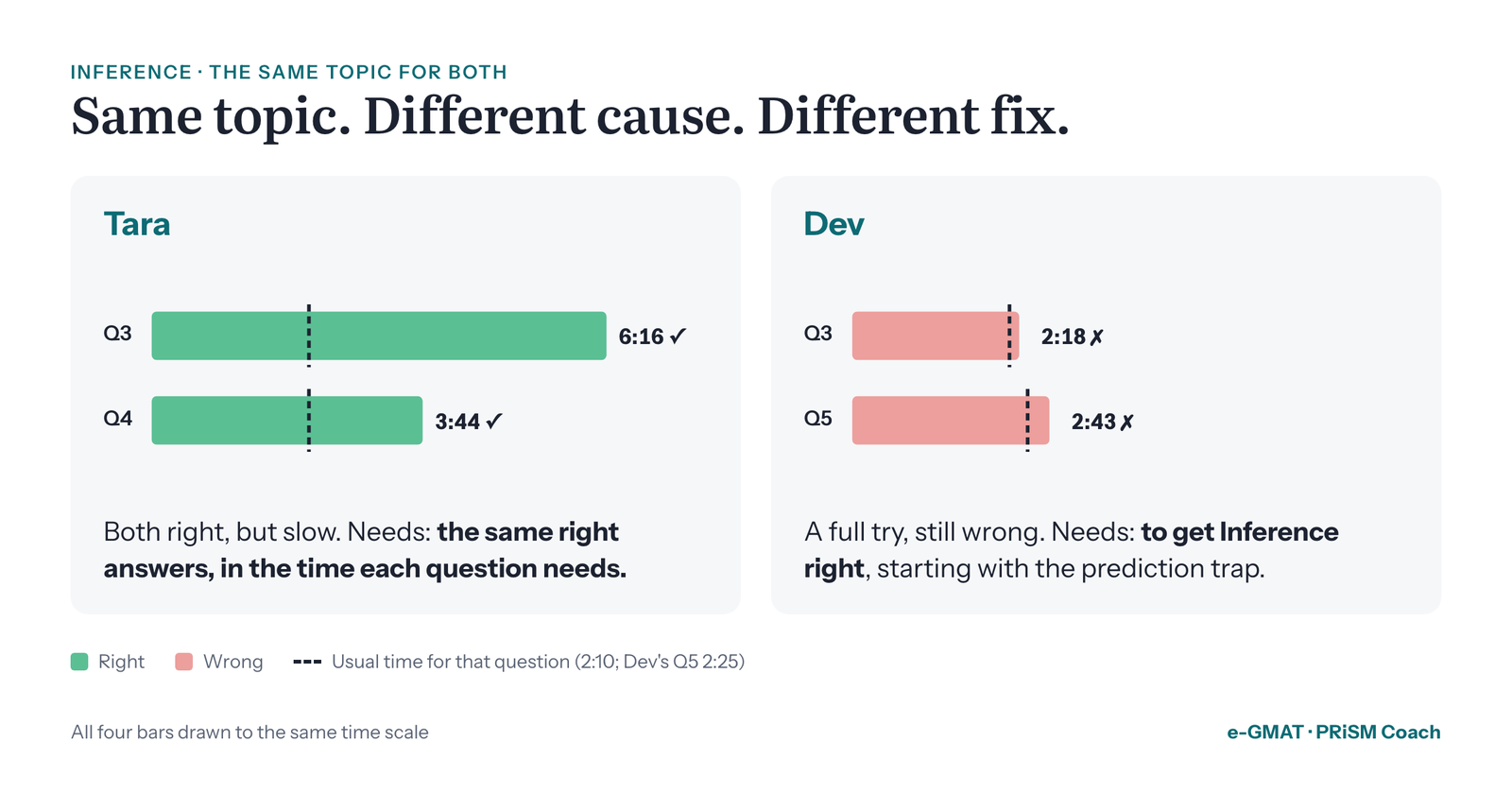
If they just do more Inference questions, Tara gets more right answers, just as slowly. And Dev keeps picking predictions without knowing it.
What both of them need to build is Inference ability. Ability means two things: getting it right, and getting it right in the time the question needs. Dev needs the first. Tara has the first and needs the second.
The time you take is a result of your skill. So you do not practice for time. You practice for skill. That is why PRiSM Coach reads accuracy and time together.
For Tara, that means the pre-thinking. Many students skip it because it feels slow, but pre-thinking is what makes you faster: without it, the five choices pull you back and forth.
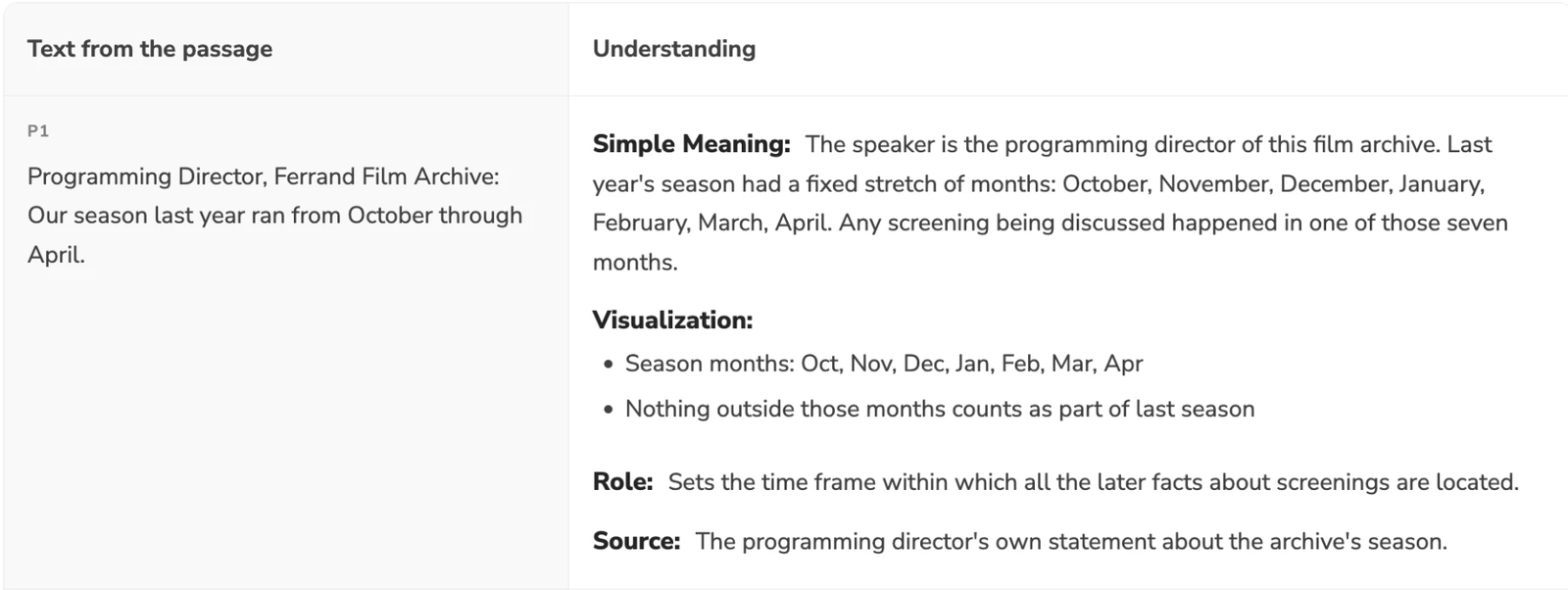
About 7 in 10 CR questions on e-GMAT now have this full teaching solution. Its passage analysis gives each part of the passage with its simple meaning, a picture of it, its role and its source.
What should you do after your next GMAT CR quiz?
Think about your own last quiz. Do you know which of your right answers took too long? Which question you should have let go? Most students cannot tell, because every question has to be read in three ways at once: right or wrong, how hard it really was (from how other students did on it), and your time against the usual time. Any quiz result shows you the first one.
PRiSM Coach reads all three after every quiz and puts each question in one of six groups. Tara and Dev showed you five of them. The sixth is judgment gaps.
| Group | What it means | What to ask yourself in CR |
|---|---|---|
| Ability gap | You had the time, but the method did not work. | Where is the first point my thinking split from the solution? |
| Speed gap | Right answer, but it took too long. | Which part took so long? Did I reread the passage, or skip the pre-thinking? |
| Judgment gap | Answered too fast while you still had time. | Did I pick a choice before I checked it against the passage? |
| Score booster | A very hard question: a bonus when you get it. | What cracked it, or when did I know I was stuck? Was it worth the time? |
| Cascade | Rushed or skipped because time ran out. | Nothing. No review needed. Fix what used up the time. |
| Mastery | Right and on time. | A quick check that I really knew it. |
As you work toward stronger performance, your review plan should get emptier, quiz after quiz: no judgment gaps, no speed gaps, nothing lost to cascade, very few ability gaps. What is left are the score boosters: a bonus when you get one, but never at the cost of a question at your level.
After your next quiz:
- Review right away, while the passage is still fresh.
- Open your review plan and start with Priority 1.
- For each question, ask the question for its group from the table above.
- Write the first point of failure into your error log. Be strict with yourself.
- Keep your eye on one number: your accuracy, against the target for the percentile you want.
Quiz after quiz, you start to catch “too long” and “too fast” during the quiz instead of after.
More practice won’t fix it. Knowing why you lost each question will.
Frequently asked questions
What is a useful next accuracy target on hard GMAT CR practice quizzes?
For the practice quizzes in this case study, use 80% as the next target. On a 10-question quiz, that means 8 right instead of 7. Practice-quiz accuracy and quiz percentiles do not directly convert to an official GMAT percentile.
Are my “silly mistakes” in GMAT CR really careless?
Not if the same kind of wrong answer shows up more than once. Read the explanation for the choice you picked. Dev picked a prediction the passage does not support on two different Inference questions: one habit, not two slips.
Should I review CR questions I got right?
Yes, when you took far longer than the usual time. A right answer that takes 3 times as long uses up time you need for later questions. Put your steps next to the teaching solution and find the part that took so long.
Does pre-thinking slow you down on GMAT CR?
No. Pre-thinking makes you faster. With it, you know what the right answer should look like before you read the choices, so the five choices do not pull you back and forth.
Do I need to review questions I did not reach because time ran out?
No. PRiSM Coach marks these cascade questions “No review needed”. Review the questions that used up your time instead.
Should I aim for 2 minutes per GMAT CR question?
No. Every question needs its own time, which is what the usual (median) time on each question shows. The time you take is a result of your skill, so practice for skill: right answers, in the time each question needs.