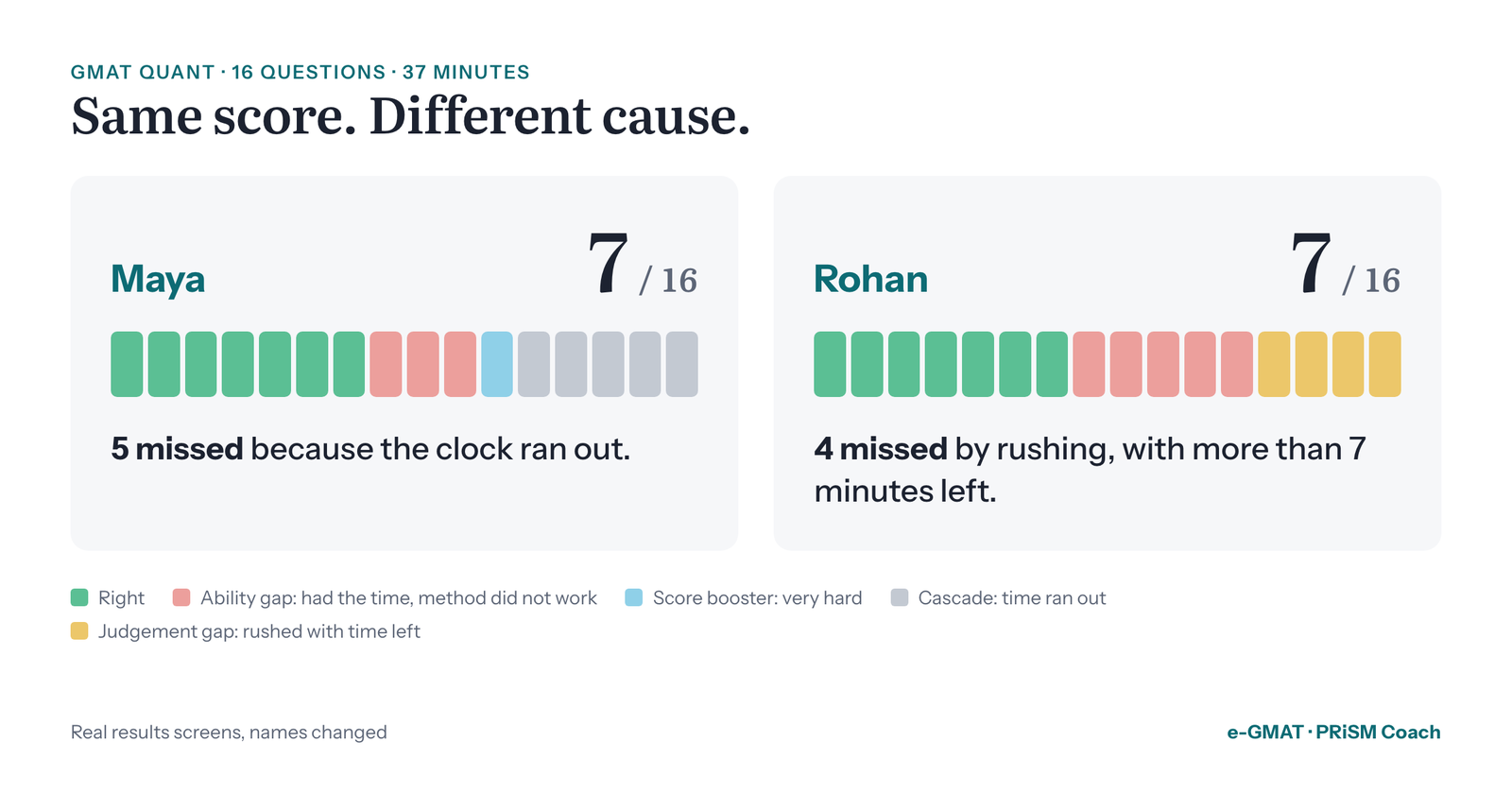
Short answer: Do not judge a GMAT practice quiz by its score. Read every question in three ways: did you get it right, how hard was it really (from how other students did on it), and how long did you take compared with the usual time. Two e-GMAT students, Maya and Rohan, both scored 7 out of 16 on a Quant quiz. Maya ran out of time because four questions took 10.5 extra minutes. Rohan rushed four questions with more than 7 minutes still left. “Practise more” would have fixed neither of them.
You finish a Quant quiz, and you get 7 out of 16. What do you do next? Most of us say the same thing: practise more.
This article shows why that answer can send you the wrong way. It uses the real results screens of two students who prepare with e-GMAT. Their names are changed.
Same score, two different problems
Maya and Rohan took the same kind of Quant quiz on the same day: 16 questions in 37 minutes. Both scored 7 out of 16, so each of them missed 9.
About half of what each of them missed had nothing to do with the math. It was about time. And time showed up in opposite ways:
- Maya missed 5 questions because the clock ran out.
- Rohan missed 4 questions by rushing, with more than 7 minutes still left.
Ask them what went wrong, and you get two confident answers.
- Maya: “I ran out of time. I need to go faster.”
- Rohan: “I had time left. So I just do not know enough. I need to study everything.”
Both sound sensible. Both are wrong. If Maya and Rohan go and practise more, both of them will fix the wrong thing.
How should you review a GMAT practice quiz?
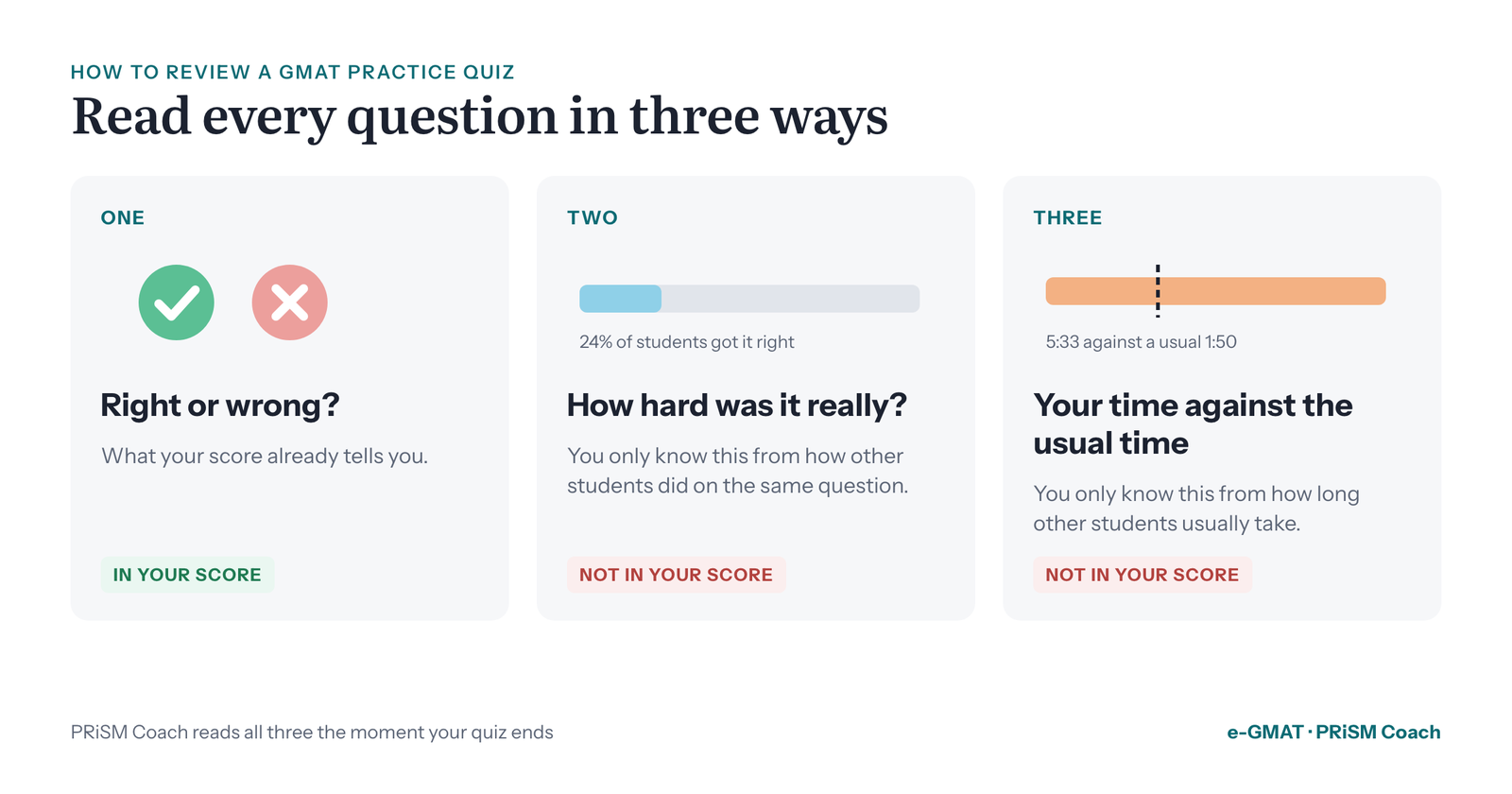
Look at every question in three ways at the same time:
- Right or wrong?
- How hard was it really? You only know this from how other students did on the same question.
- How long did you take, compared with how long other students usually take?
Your score shows you only the first one. To see the other two, you need data on every question from many other students, and the time you spent on each question. Working that out by hand for 16 questions after every quiz is slow work.
At e-GMAT, PRiSM Coach does this for you. It is built into the results screen and reads your quiz the moment you finish it. It puts every question into one of six groups and gives you a review plan, in order. Here is what it showed Maya and Rohan.
Why did Maya run out of time on Quant?
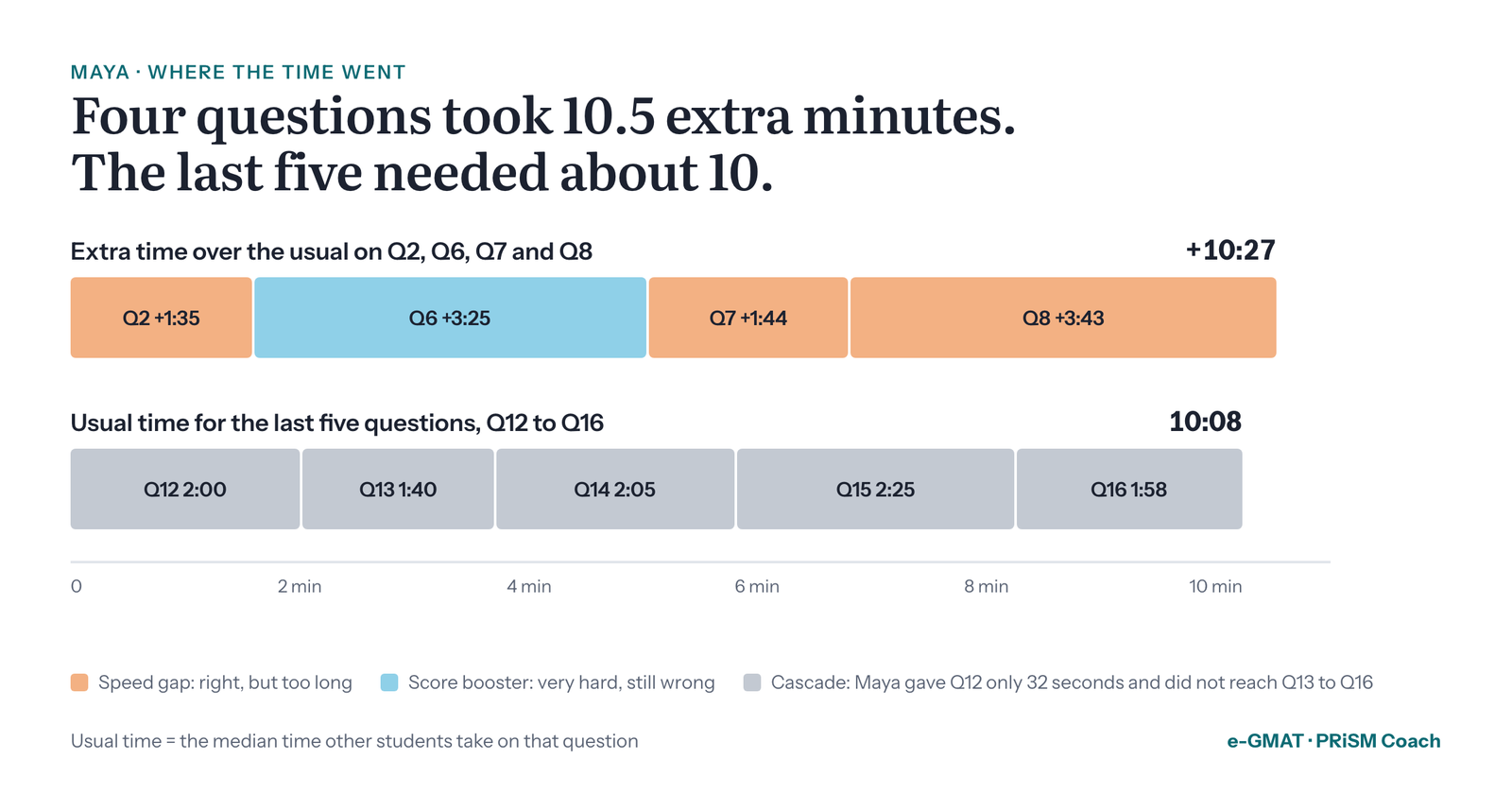
Four questions used up the time. Together, they took 10.5 minutes more than usual. The five questions at the end, the ones Maya barely got to, would usually need about 10 minutes.
Maya’s time chart says it plainly: “Clock tight from Q7 · 17:57 left, 21:51 needed.” So Maya really did run out of time.
But “go faster” is not a plan. Which step do you speed up? The reading? The setting up? The calculation? And by how much? Most of us do not know. The better question is: where did the time go?
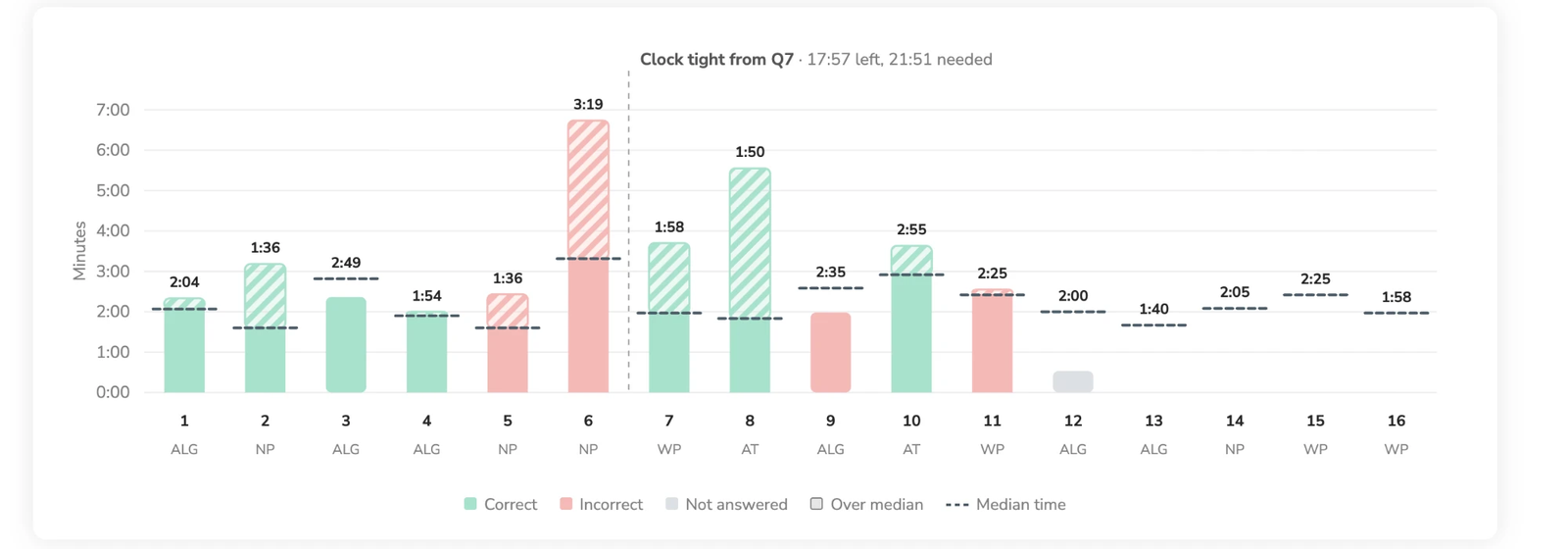
The dashed line on each bar is the usual time for that question. Most of Maya’s bars are close to it. Four of them go far above it:
| Question | Time over the usual |
|---|---|
| Q2 | +1:35 |
| Q6 | +3:25 |
| Q7 | +1:44 |
| Q8 | +3:43 |
| Total | +10:27 |
The last five questions would usually need 10:08 in all. Maya gave question 12 only 32 seconds and did not reach questions 13 to 16. So the time did not just disappear. It went into those four questions.
Should you review GMAT questions you got right?
Yes, when you took far longer than usual. At e-GMAT, we call these speed gaps: right answer, but it took too long.
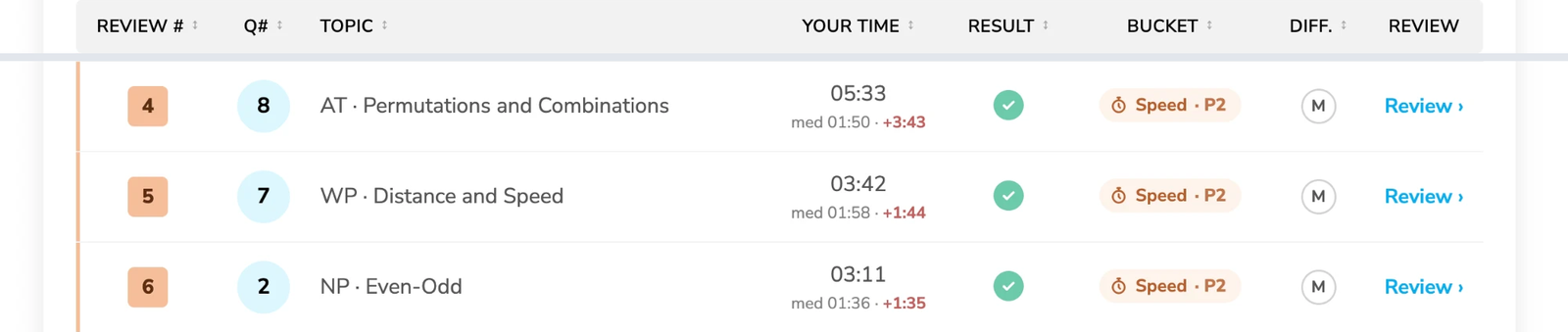
Three of Maya’s four slow questions were right: Q2 (Even-Odd, 3:11), Q7 (Distance and Speed, 3:42) and Q8 (Permutations, 5:33).
Most students never go back to a question they got right. And even if they did, what would they look for? They got it right.
Look at question 8. Maya took 5 minutes 33 seconds. The usual time is 1:50, so Maya took about three times as long. When you review a right answer like this, you are looking for the extra time. Put your own steps next to the solution and ask yourself: which of my steps took so much longer? That is how you get faster. One step, on one kind of question, at a time.
When should you give up on a hard GMAT question?
When you know you are stuck and you are not getting closer to the answer. On a very hard question, the skill is not always solving it. The skill is knowing when to let it go.
Maya’s fourth slow question was question 6. Maya spent 6 minutes 44 seconds on it, against a usual time of 3:19, and still got it wrong. Only about one in four students gets this question right. At e-GMAT, we call it a score booster: a very hard question that is a bonus when you get it. You will see questions like this on the real GMAT too.

So how do you learn when to stop? After the quiz, ask yourself two questions: at what point did I know I was stuck and not getting closer to the answer? And why did I keep going? If you ask these after every quiz, you slowly start to feel what “too long” feels like while it is happening. Then you start catching it during the quiz, not after.
Do you need to review questions you missed because time ran out?
No. Those questions were lost to time spent earlier, so fix what used up the time.
PRiSM Coach puts Maya’s last five questions in a group called Cascade and says: “No review needed.” Maya missed them only because the other four questions used up the time.
Now look at Maya’s 7 out of 16 again, in the order PRiSM Coach gives it:
- Ability gaps (3): Maya had the time, but the method did not work.
- Speed gaps (3): right answers that took far too long.
- Score booster (1): one very hard question, where the skill is letting go.
And the Cascade (5): no review needed.
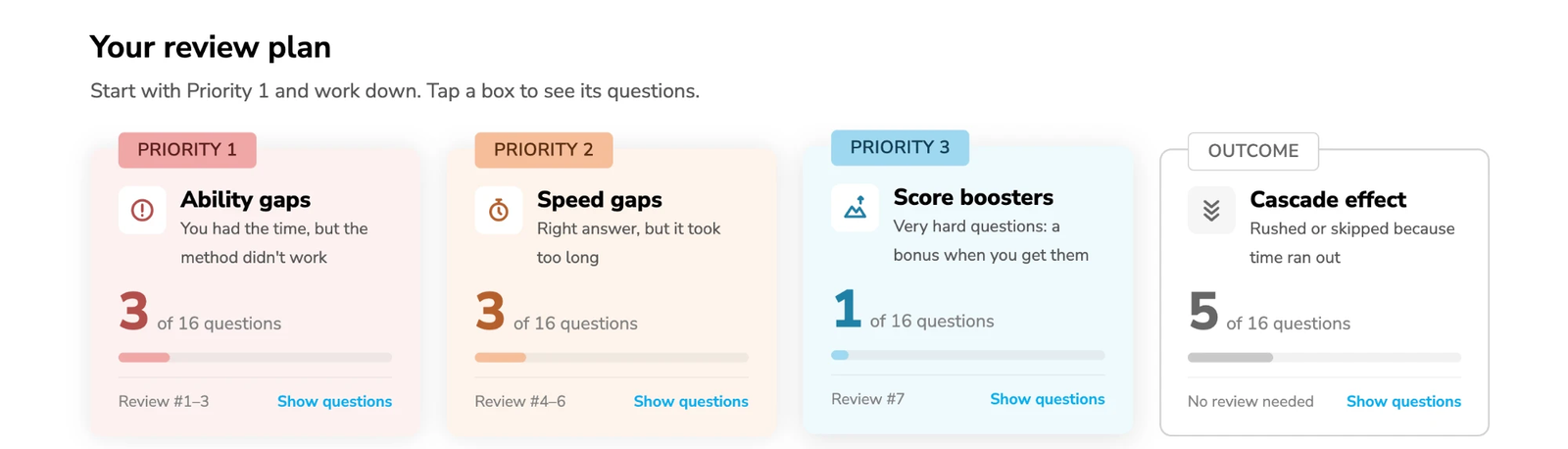
So instead of “go faster”, Maya now has a short list to work on. Fix those, and Maya will have the time for the questions at the end.
And if Maya had just tried to go faster anyway? Maya would have started rushing. That is exactly what happened to Rohan.
Why do you miss GMAT questions when you finish early?
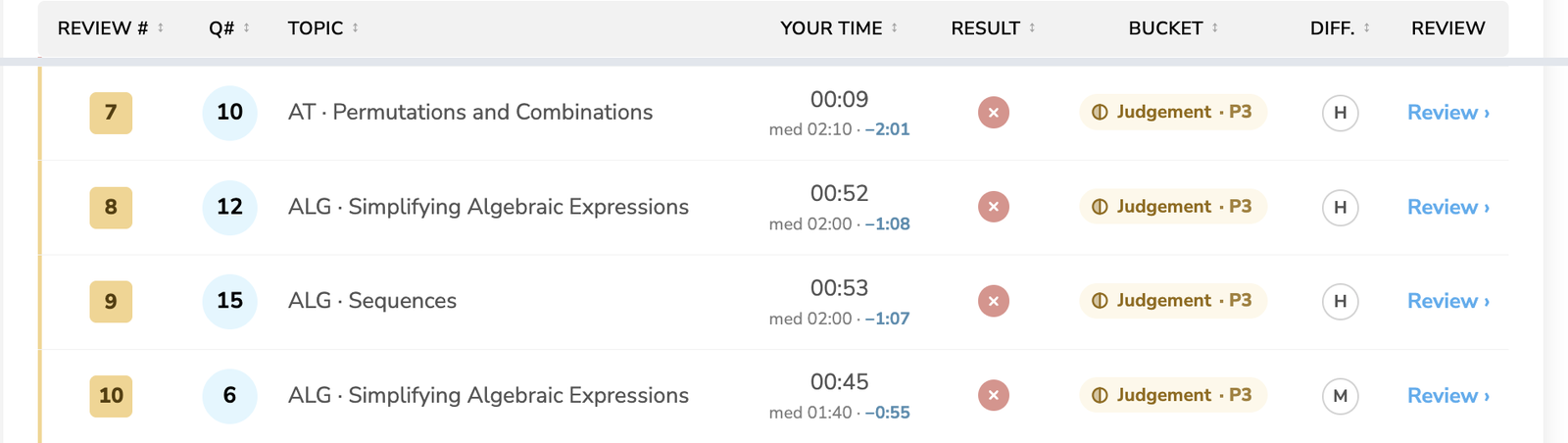
Often because you rushed questions you could have solved. Rohan finished with more than 7 minutes left, and 4 of Rohan’s 9 misses were answered in under a minute.
At e-GMAT, we call these judgement gaps. PRiSM Coach describes them as “Answered too fast while you still had time.”
| Question | Rohan’s time | Usual time |
|---|---|---|
| Q10 | 0:09 | 2:10 |
| Q12 | 0:52 | 2:00 |
| Q15 | 0:53 | 2:00 |
| Q6 | 0:45 | 1:40 |
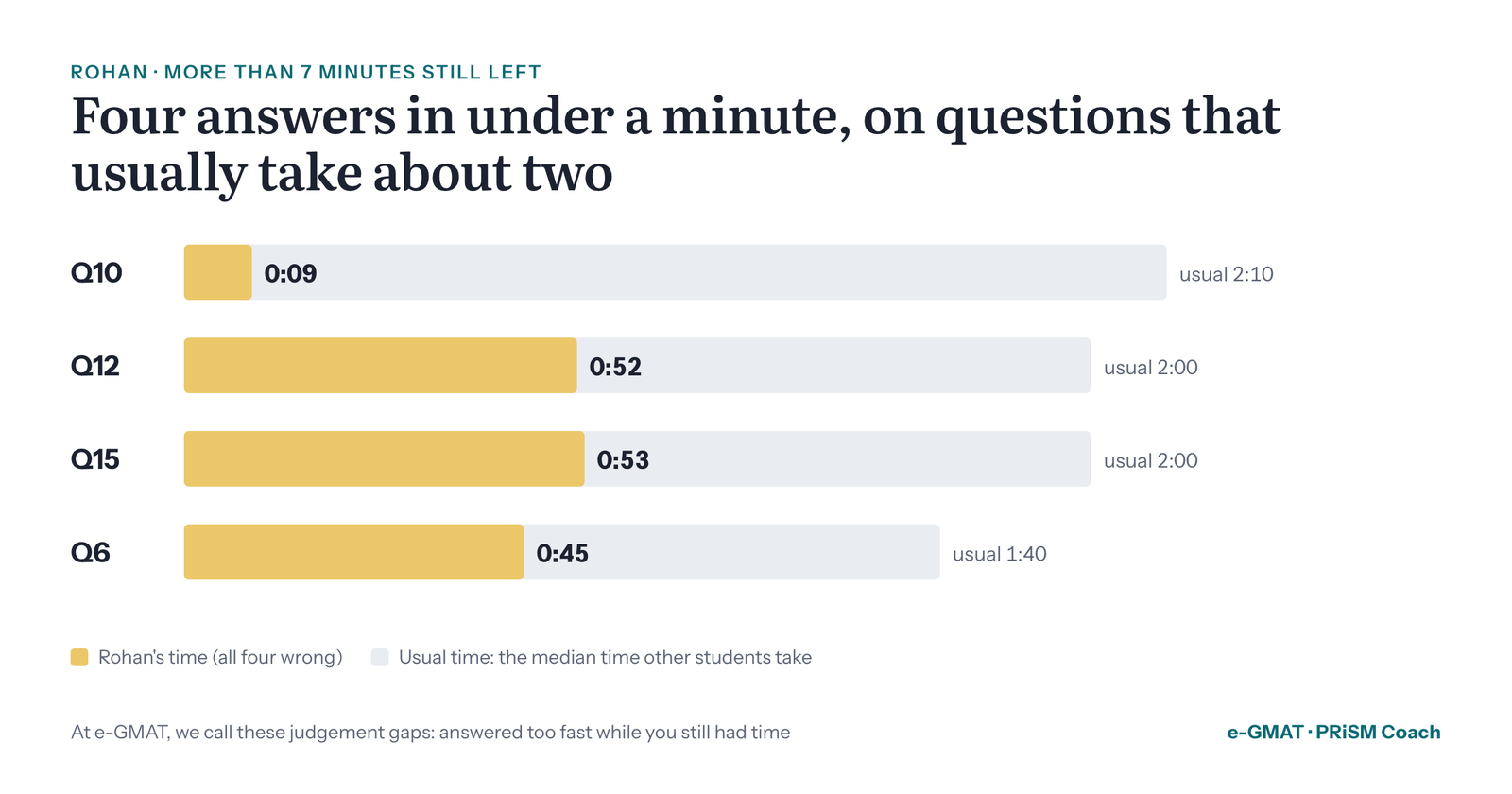
Nine seconds. Can you even read a GMAT question in nine seconds?
So would studying everything fix even one of these four? No. These questions do not need more studying. They need a fair try.
What should Rohan actually study?
Five questions, not everything. And three of those five point to one area.
Here is Rohan’s 7 out of 16, in the order PRiSM Coach gives it:
- Ability gaps (5): Rohan had the time, but the method did not work. Q8 (Even-Odd), Q9 (Estimation and Rounding) and Q7 (Even-Odd) are all Number Properties. The other two are Q13 (Quadratic) and Q3 (Distance and Speed).
- Speed gap (1): Q5 (Mixtures), right, but 5:01 against a usual 1:58.
- Judgement gaps (4): the four rushed questions.
The other 6 are Mastery: right and on time.
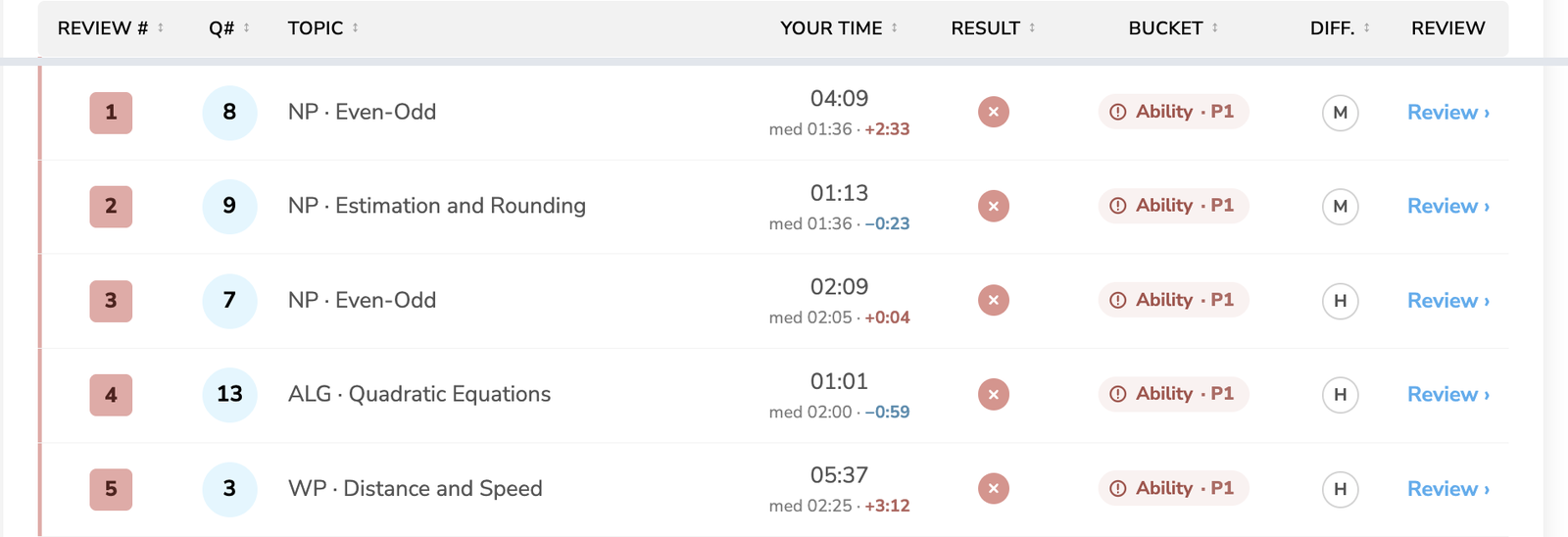
Three ability gaps in Number Properties means something in that area is tripping Rohan up. It could be a concept Rohan does not know well. Or it could be a process skill: a step in how Rohan works these questions. The teaching solutions for these three questions will show Rohan which one it is.
So instead of “study everything”, Rohan now has a short list to work on. And Rohan actually knows more than the score says.
What are the six question groups, and what do you do with each?
PRiSM Coach puts every question in your quiz into one of six groups. Each group needs a different kind of review, and some need none.
| Group | What it means | What to ask yourself |
|---|---|---|
| Ability gap | You had the time, but the method did not work. | Was it an idea I did not know, or a step in how I worked the question? |
| Speed gap | Right answer, but it took too long. | Which of my steps took so long? |
| Judgement gap | Answered too fast while you still had time. | Did I skip a step just to move on? |
| Score booster | A very hard question: a bonus when you get it. About a third or fewer of students get these right. | At what point did I know I was stuck? Why did I keep going? |
| Cascade | Rushed or skipped because time ran out. | Nothing. No review needed. Fix what used up the time. |
| Mastery | Right and on time. | A quick check that I really knew it. |
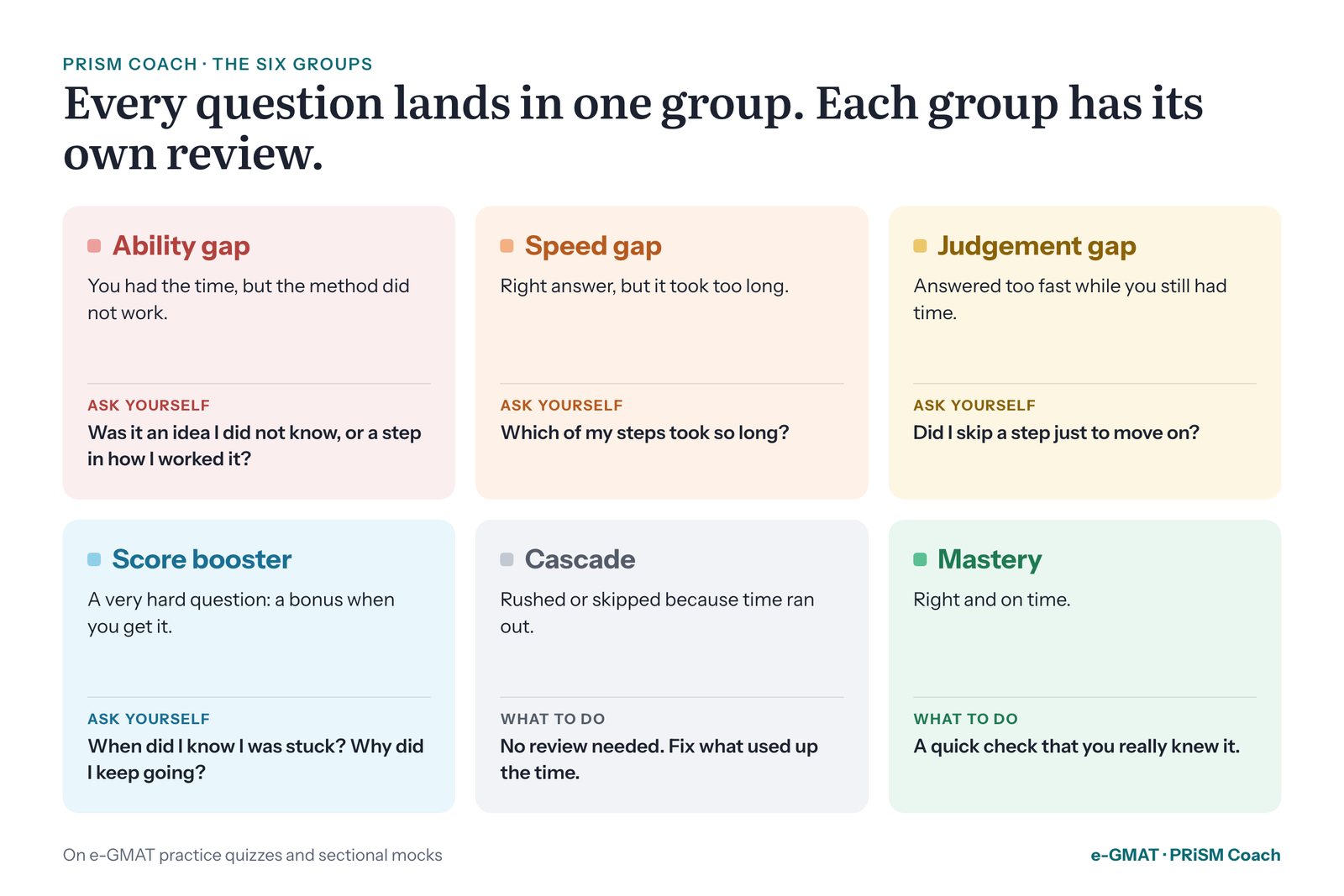
PRiSM Coach also tells you the order to review them in, and gives you a teaching solution for each question. So you can put your own thinking next to the best one and see exactly where yours went a different way. The groups appear on practice quizzes and sectional mocks, not on full mocks.
What should you do after your next GMAT quiz?
Before you do anything else:
- Open your review plan.
- Start with Priority 1 and work down.
- For each question, ask the question for its group from the table above.
Do this after every quiz, and you start to feel “too long” and “too fast” while you are still in the quiz.
Same score. Different cause. Different fix.
Frequently asked questions
Does a low GMAT practice quiz score mean I do not know the content?
Not always. Maya and Rohan both scored 7 out of 16, and for each of them, about half of the missed questions were about time, not the math. Check your time on each question before you decide what to study.
Should I review GMAT questions I got right?
Yes, if you took far longer than the usual time. A right answer that took three times as long costs you time for later questions. Put your steps next to the solution and find the step that took longer.
How do I know when to give up on a hard GMAT question?
After each quiz, look at the very hard questions you spent too long on. Ask yourself when you knew you were stuck and why you kept going. Over a few quizzes, you start to notice it during the quiz.
Do I need to review questions I missed because time ran out?
No. At e-GMAT, these are called cascade questions, and PRiSM Coach marks them “No review needed”. Review the questions that used up your time instead.
What is the difference between an ability gap and a judgement gap?
An ability gap is a question where you had the time, but the method did not work. A judgement gap is a question you answered too fast while you still had time. For an ability gap, compare your work with the teaching solution to find the missing idea or step. For a judgement gap, give the question a fair try next time.
Does PRiSM Coach work on full GMAT mocks?
PRiSM Coach sorts questions into the six groups on practice quizzes and sectional mocks. It does not do this on full mocks.