The short answer: The day before your GMAT, stop studying by afternoon, confirm your passport matches your registration name letter for letter, plan your travel with at least a 60-minute buffer, and sleep a full night. On test day, arrive 30 to 45 minutes early and, if anything goes wrong, take one minute to breathe before you start. Your ability is roughly 80 percent of your score. Everything on this page is about protecting the other 20 percent.
We talk about success stories all the time. A student crosses 705, and we celebrate it, and that is worth sharing. But there is another story we rarely tell. It is about students who had the ability to do well and still fell short on the day of the exam.
This article is about three of them. Three real e-GMAT students. All three had the ability. All three scored below what they were capable of. We have changed their names. Nothing else.
First, understand what a good score is made of
A good GMAT score is not one thing. It is many things done right.
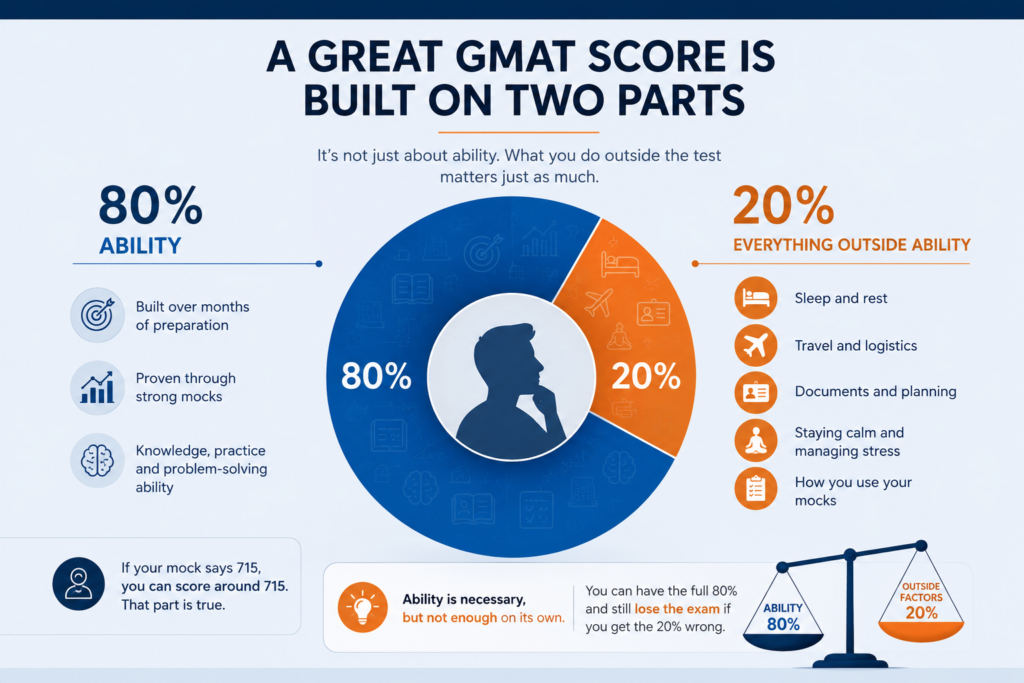
Think of it as two parts.
About 80 percent is ability. You build it through months of prep, practice, and mocks. A strong mock is real proof that you have this ability. It is not luck. If your mock says 715, you can score around 715, and for most people it does. Across 50 e-GMAT students who recently sat the GMAT, about 80% of these students scored within 40 points of their recent mock average. This article is about the rest, and especially the 20% who fell 60 points or more below it, because that drop is almost never about ability.
The other 20 percent is everything outside ability. It is what you do the day before the exam and on the day itself. It is your travel, your sleep, your documents, your calm, and how you use your mocks. It is small, but it is not optional.
Here is the point. Ability is necessary, but it is not enough on its own. You can have the full 80 percent and still lose the exam if you get the 20 percent wrong.
That is what happened to all three students below. Their ability was there. They lost the 20 percent that no one talks about.
Kabir: late in the rain, and he rushed
Kabir prepared for about six months. His mocks were strong. He scored 715 and then 725 in the week before his exam. The ability was there.
His exam fell in a week of heavy rain. In his city, even an hour of rain floods the roads and slows the traffic. He knew this. He did not plan for it. On the day he took a rickshaw, because anything else would have been slower.
He reached the centre 7 minutes late. He started the test about 10 minutes behind.
Here is what that does to you. When you are stressed and rushing, your body releases cortisol and adrenaline. These are made for running from danger, not for sitting an exam. They put you in a fight-or-flight state. In that state, the thinking part of your brain, the part you use to reason carefully and to hold a few steps of a problem in your head, does not work at its best. So a rushed, panicked start does not just feel bad. It quietly weakens the exact thinking the GMAT is testing.
Kabir felt he could not spare a minute to calm down, so he did not. His first section was Quant, his strongest area. He rushed through it to make up the lost time. He did not get stuck on a question. He simply hurried.
He scored Q80. He said later that if he had taken a moment to settle, he would have done his best on at least the first 15 questions, and that alone could have made it Q85 or higher.
His final score was 625, with Q80, V80, and DI83.
What you should learn from Kabir: the minute you take to calm down is not wasted. Slow breathing brings your body out of that stressed state and lets the thinking part of your brain come back online. Rushing costs more than it saves. And the calm you need on the day starts with the plan you make the day before.
Nikhil: the passport reached in time, and still cost him
Nikhil prepared for about four months. His mocks sat in the mid 600s, around his target. The ability was there.
His exam was on a Friday. His centre was about 1,000 km away. He took a train on Wednesday night and reached on Thursday.
There he realised he did not have his passport. And here is why that matters so much: at a test centre in India, a valid passport is the only ID accepted. Not Aadhaar, not PAN, not a driving licence, not a photocopy. No passport means no exam, and the fee is forfeited. He arranged for it to be sent, and it reached him on Thursday, in time for the exam. On paper, the problem was solved.
But he spent all of Thursday worried about it. He kept checking his phone to see if it had been delivered. He did not rest the way you should the day before an exam.
He says it did not affect him much, and that his focus and energy felt fine. That may be true on the surface. But a stressful day has a cost you do not always feel. The cortisol from that stress does not leave your body the moment you decide to stop worrying. It stays for a while. On top of that, a worried mind sleeps worse, and poor sleep before an exam makes it harder to focus, to recall what you know, and to stay sharp for three hours. You do not notice any of this happening. It still shows up in the score.
His final score was 605, with Q82, V78, and D77. Below what he could do.
What you should learn from Nikhil: the exam does not start with the first question. It starts the day before. If you are travelling, carry your documents on you, never send them separately, and reach early, so your last day is calm and not spent waiting on a delivery.
Arjun: he chased a perfect score and tired himself out
Arjun had the highest ceiling of the three. His mocks climbed to 745. He regularly scored Q90. The ability was not in doubt.
His problem was that he wanted every attempt to be perfect. One or two wrong answers made him anxious. A Q86 or Q87 in a mock, which is a strong score, was enough to worry him. He would take questions personally, on his ego.
Because he could not fully trust his own results, he kept looking for more proof. The day before his exam, he sat a full official GMAT practice test. He scored well on it, around 745. But that was not the point. He had just spent a whole day taking a full test, and he walked into the real exam tired.
Fatigue matters more than people think. Your brain uses real energy to concentrate, and after a long test that energy is low. When you are tired, the first thing to go is patience and steady attention. Fatigue does not lower your ability. It lowers how much of that ability you can actually use on the day.
You can see it in his score. He had taken the exam once before and scored 655. This time he scored 655 again. But look at the shape of it. Quant, which he could almost do on instinct, held up at Q90. Verbal and DI, which need patience and focus, both fell below 80, to V78 and DI79. The tired parts of his mind gave way first.
What you should learn from Arjun: the day before the exam is for rest, not for one more test. And do not chase a perfect score. One or two wrong answers are normal. If a question hooks your ego, mark it and move on.
The checklist: protect the 20 percent
Your ability is built by now. What follows is a verified, hour-by-hour protocol. All test-centre policies below are current as of July 2026. Confirm them on mba.com before your exam, as GMAC updates rules from time to time.
What ID do I need at the test centre?
- In India, a valid passport is the only accepted ID at a test centre. Aadhaar, PAN, driving licence, and photocopies are not accepted.
- Your first and last name on the registration must exactly match your passport, letter for letter. Check this on your mba.com account today, not the night before. If there is a mismatch, contact GMAC Customer Care. Exceptions need approval at least 5 business days before your appointment.
- If your passport is expired or sitting with an embassy for a visa, you cannot test at a centre. Fix this before you book.
Should I study the day before the exam?
No mock, and ideally no studying after mid-afternoon. This is Arjun’s lesson: a full-length test the day before drains exactly the patience and sustained attention that Verbal and DI demand. If you must do something, review your error log or a one-page strategy note for 30 minutes in the morning, then stop. Your ability will not grow in the last 24 hours, but your fatigue can.
48 hours before (T-48)
- If your centre is in another city, travel now, not the night before. A delayed train on Wednesday cannot hurt a Friday exam. (Nikhil’s rule.)
- Book a hotel close to the centre, not across town.
- Confirm your appointment date, time, and centre address on your mba.com account.
- Verify your passport is in your bag. Physically look at it.
The day before (T-24)
- Visit the centre if you can. See the route, the building, the parking, the gate. This one dry run removes most of test-morning uncertainty.
- Book your cab in advance for the morning. Have a backup plan (a second app, an auto stand, a family member on standby).
- Check the weather forecast. If rain is likely, double your travel buffer. Kabir knew an hour of rain floods his city’s roads. Knowing is not planning.
- Pack tonight: passport, appointment confirmation, water bottle and a light snack for the locker, a layer in case the room is cold.
- Eat a normal dinner. Nothing new, nothing heavy.
- In bed 8 to 9 hours before you need to wake. For an 8:00 AM slot with a 6:15 AM wake-up, that means lights out by 9:30 to 10:00 PM. A worried mind sleeps worse, which is exactly why every item above happens beforetonight.
Test morning (T-0)
- Leave with a buffer of at least 60 minutes over your normal travel time. Arriving very early costs you nothing. Arriving late can cost you the attempt.
- Plan to reach the centre at least 30 minutes before your appointment. Check-in takes time: passport verification, a digital photograph, a digital signature accepting the Test Taker Rules, and at some centres a palm vein scan.
- Phones, watches, bags, and food go in the locker. You will carry only your passport into the room. Your snack and water stay in the locker, and you can access them only during the break.
- Eat a familiar breakfast. Caffeine only if it is part of your normal routine.
What if I arrive late or shaken? (Kabir’s protocol)
Take one minute to breathe before you begin. Slow exhale, longer than the inhale, six to eight times. It feels like the one minute you cannot afford. It is the one minute you cannot afford to skip. It is what brings the reasoning part of your brain back online. Then start at your normal pace. Do not rush to win back lost time. Rushing costs more than it saves. Kabir’s Q80 was not a knowledge problem. It was a pace problem in the first 15 questions.
How the exam itself works, and your in-test protocol
The GMAT is 2 hours 15 minutes. It has three 45-minute sections, Quant (21 questions), Verbal (23 questions), and Data Insights (20 questions), in the order you choose.
The break. You get one optional 10-minute break, after the first or second section, not both. Take it. Leave the room, stretch, sip water, eat your locker snack. Do not think about the section you just finished. It is submitted and gone. Return a minute early, re-verification takes time.
Pacing checkpoints. You have roughly 2 minutes per question. Set two mental checkpoints per section: at the 15-minute mark and the 30-minute mark, you should be about a third and two-thirds through. If you are behind at a checkpoint, do not speed up on every question. Pick the one question in front of you that looks longest, make your best reasoned guess, bookmark it, and move on. One deliberate skip buys back more time than rushing five questions.
Mark it and move on, literally. The exam has a bookmark and a Question Review & Edit feature: bookmark as many questions as you like, and after the last question of a section (if time remains) you can revisit any of them and change up to 3 answers. This is Arjun’s ego-rule turned into a mechanic. A question that hooks you gets an answer, a bookmark, and your absence. Note the catch: if the section clock runs out, the review screen never appears, which is one more reason not to fall behind.
One bad patch is not a bad score. Arjun scored Q90 while V and DI fell. The sections are scored independently, and a rough stretch in one does not poison the next. Between sections, reset: the last section no longer exists.
In the end
Ability gets you ready. It is about 80 percent of the job, and your mocks prove you have it. But the last 20 percent, your sleep, your travel, your documents, and your calm before you start, is what turns that ability into a score. It is small, and it is the easiest thing to forget in the rush of the final days.
All three of these students had what it takes, and each lost points that had nothing to do with how much they knew. So build your ability, then give the last stretch the same care you gave the months before it. Do that, and the score you have earned is the score you actually walk away with.
Read next
- Test Day Tips that actually matter
- Scored below your ability? A retake strategy that doesn’t restart your prep
- GMAT Exam Day Tips – Checklist for the D Day
Policy facts (India passport-only ID, exact name match, 30-minute arrival, exam structure, break rules, Review & Edit limits) verified against mba.com and current 2026 sources as of July 2026. Re-verify each admissions cycle.