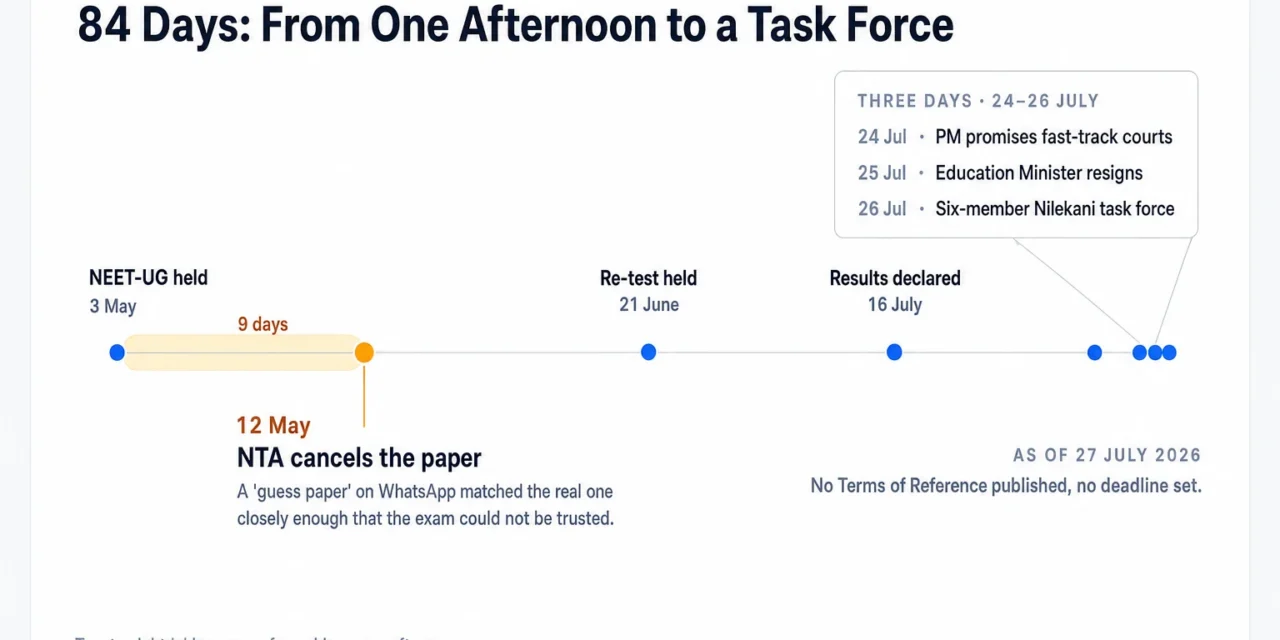
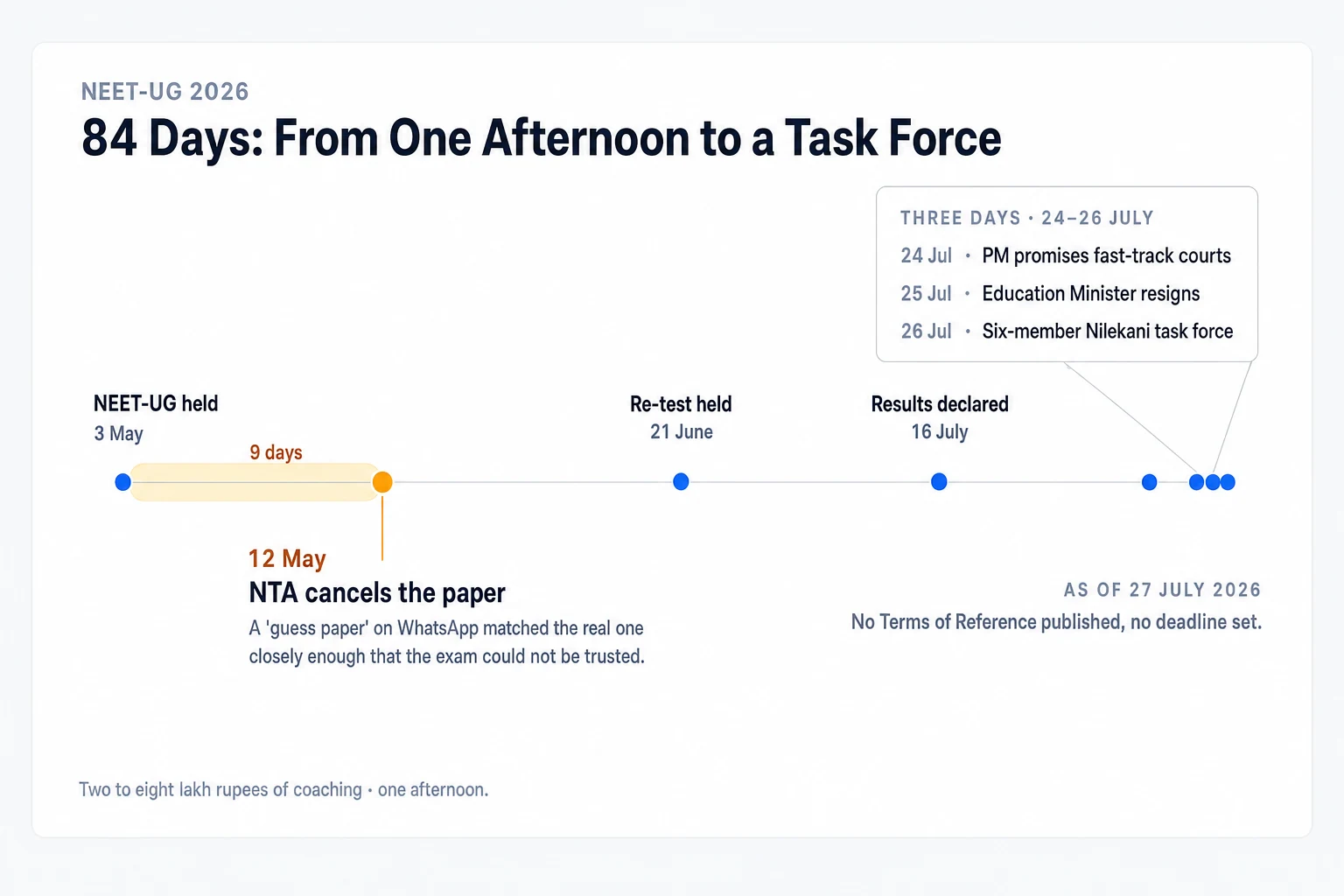
On the morning of 3 May 2026, a father in Nagpur did what tens of thousands of parents did that day: he dropped his daughter at a NEET centre, drove home, and started counting down the years of money — somewhere between two and eight lakh rupees in coaching — against the one afternoon that would decide whether it had been worth it. Nine days later, on 12 May, the National Testing Agency cancelled the paper. A “guess paper” circulating on WhatsApp had matched the real one closely enough that the exam could not be trusted. There would be a re-test on 21 June; results on 16 July; a Prime Ministerial promise of fast-track courts on 24 July; the Education Minister’s resignation on 25 July; and, on 26 July, a six-member task force under Nandan Nilekani to fix the whole thing.
If you are that father, or that daughter, the question you are actually carrying is not “when is the re-test.” You know that. The question is quieter and much larger: should I bet another year and another few lakh on this machine — and is it a machine that was ever built to be fair?
This article answers that by doing one thing: running India’s last 165 years of exam decisions — 16 of them, dated and sourced — through a single test, and by checking the fear underneath it all (maybe India is just too big for a fair exam) against the two countries that actually run exams at our scale.
Key takeaways
- The pattern. Across 165 years and 16 major decisions, India’s exam changes were repeatedly announced as fairness or integrity measures but, by design and effect, mostly served administrative tractability and institutional interest. The genuine integrity investments were deferred at almost every turn. The verdict is upheld — but not absolute; the record carries real integrity strands, and we show them.
- The tool. Every exam decision serves one or more of four drivers — D1 Integrity, D2 Tractability, D3 Access, D4 Interest. Classify by design and effect, not by the announcement. That one rule lets you judge any reform yourself.
- Where exams actually break. Two surfaces a screen closes neither: the physical chain of custody (an estimated ~85,000 handover points at 22-lakh scale) and seat economics (an incentive on the order of ₹1.45 crore per candidate). Organised cheating is a market response to seat scarcity, not a technology failure.
- “Too big” is false. Nigeria (full computer-based testing) and Brazil (paper + custody redesign) both held integrity at or above India’s scale — through different levers, and through sustained investment India has not made.
- The 2026 test. Watch whether the Nilekani task force’s published Terms of Reference fund a continuous item-bank and psychometric capability (D1) — or merely announce a new format and stiffer penalties (D2/D4).
Here is the reframe this article is built around, because it is the one that will actually help you decide. Almost everyone is asking whether going digital — computer-based testing, biometrics, tougher jail terms — will finally stop the leaks. That is the wrong question. It substitutes is the reform modern? for is the reform aimed at where exams actually break? The right question, the one you can apply to any reform now on the table, is this:
Does this change fund the thing that makes an exam genuinely hard to compromise — or does it just make the exam cheaper to run, easier to control, or better to announce?
Answer that, and you can classify the Nilekani task force’s eventual output yourself, without waiting for anyone to tell you what to think. And when you run India’s last 165 years of exam decisions through that question — as we will, one decision at a time, with dates and primary sources — a pattern emerges that is uncomfortable but well-evidenced: decisions repeatedly announced as fairness or integrity measures were, by design and effect, mostly optimised for administrative tractability and institutional interest, while the genuine integrity investments were deferred at almost every turn. Not a conspiracy. A default. We will state that verdict no more strongly than the evidence allows, and we will show you the places where it does not hold.
Two countries at our scale — Nigeria and Brazil — tell you the fear underneath all of this (“maybe India is just too big for a fair exam”) is false. But they only earn that verdict when you carry them to outcomes, not intentions. We will.
What are the four drivers behind every exam decision?
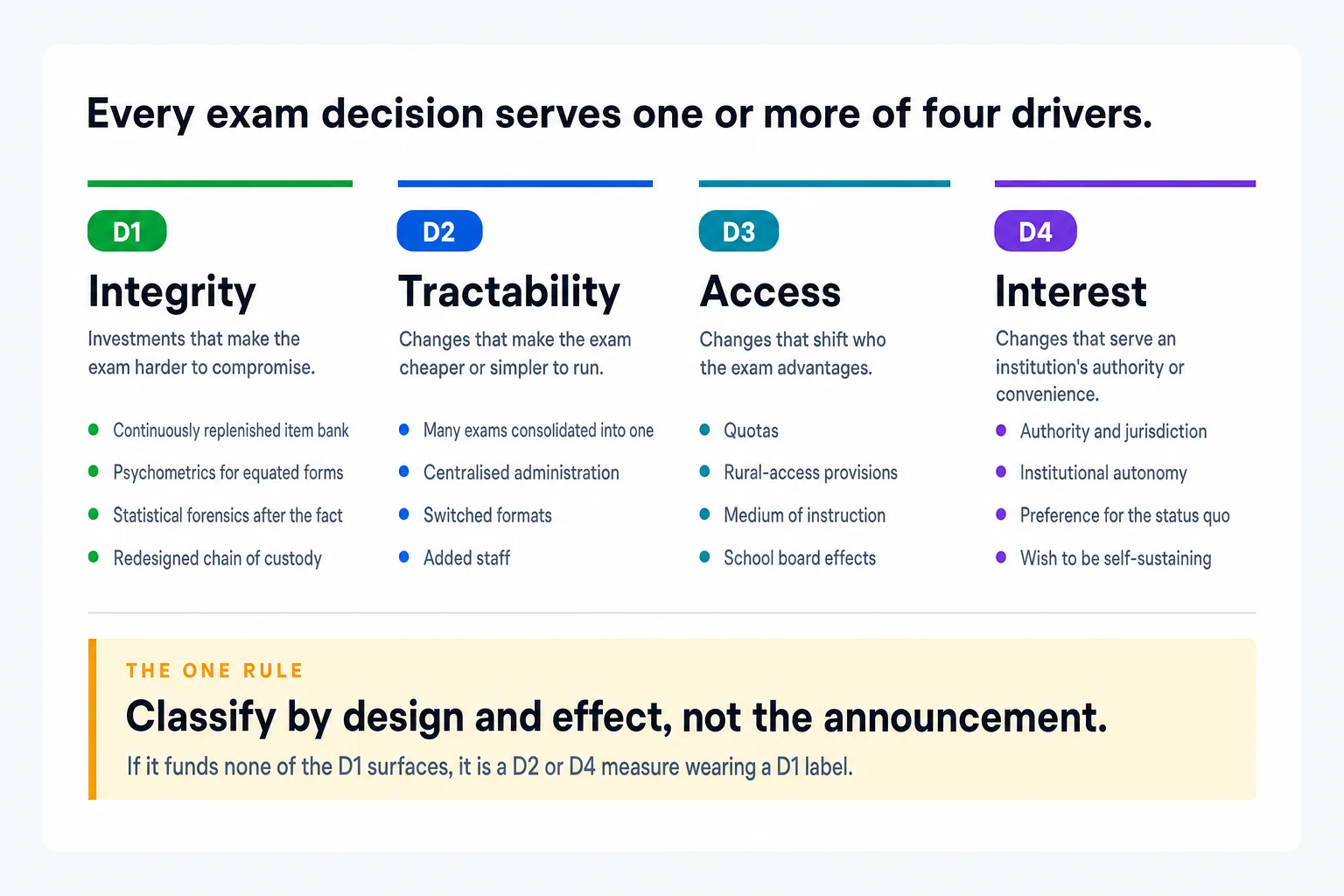
Every exam decision serves one or more of four drivers. Naming them is most of the work. Before the history, the tool.
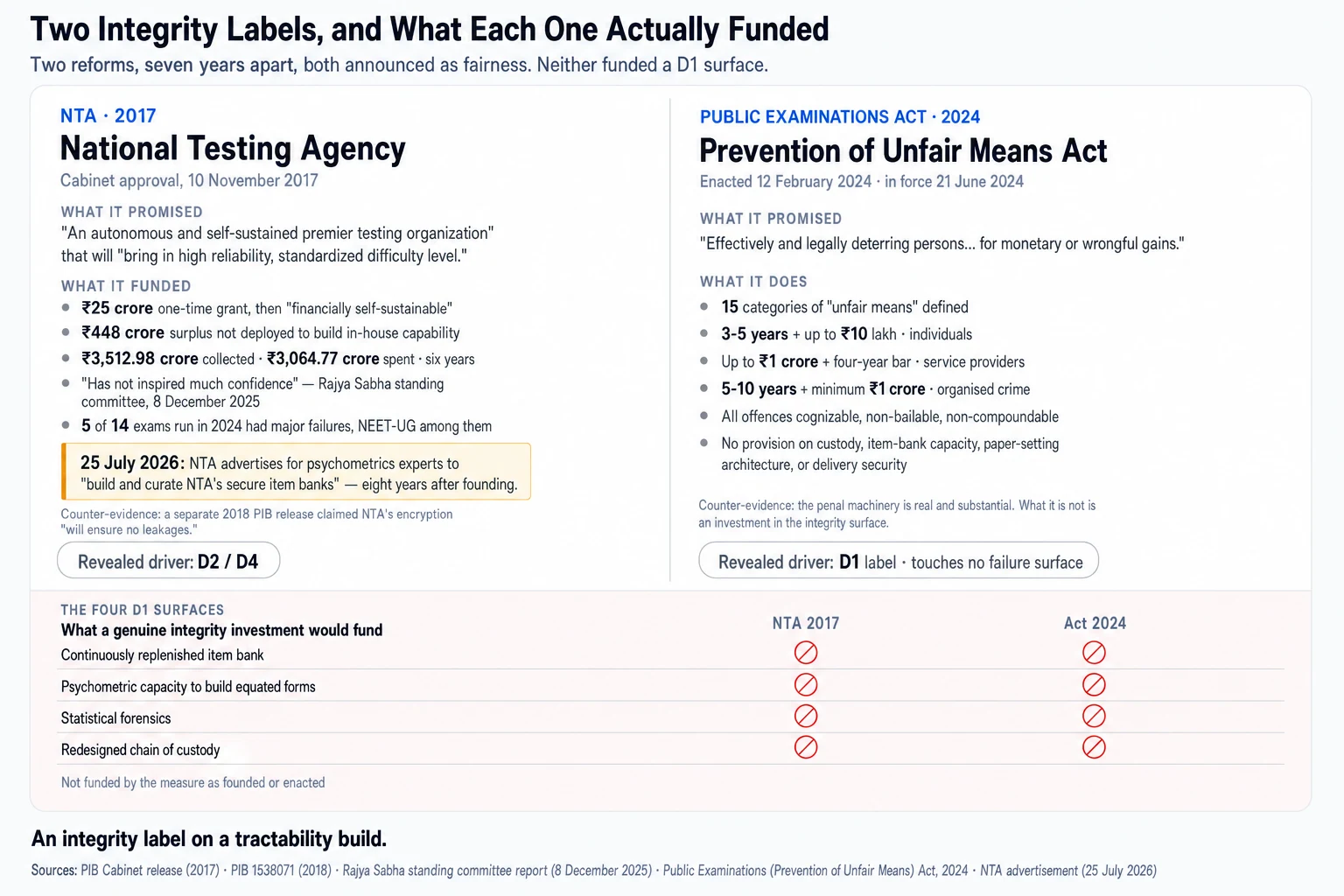
- D1 — Integrity. Investments that make the exam genuinely harder to compromise: a large, continuously replenished item bank; psychometric capacity to build equated forms; statistical forensics that catch anomalies after the fact; and a redesigned chain of custody for papers and data.
- D2 — Tractability. Changes that make the exam cheaper or simpler to run: consolidating many exams into one, centralising administration, switching formats, adding staff.
- D3 — Access. Changes that shift who the exam advantages: quotas, rural-access provisions, the effect of medium of instruction or school board.
- D4 — Interest. Changes that serve an institution’s authority, autonomy, jurisdiction, or convenience — including the deep human preference for the status quo, and the wish to be “self-sustaining.”
The one rule that makes the framework work: classify by design and effect, not by the announcement. A measure branded as an integrity reform that touches none of the D1 surfaces — that adds no item-bank capacity, no forensics, no custody redesign — is a D2 or D4 measure wearing a D1 label. Hold onto that. It is the whole game.
What existed before NEET?
Before NEET, medical admission ran through a patchwork of state and institutional exams — by 2010, roughly 35 separate medical entrance exams for some 412 colleges — layered on more than a century of exam machinery inherited from colonial rule and three decades of Supreme Court rulings about private-college fees. And from the start, the stated reason and the built thing were two different animals.
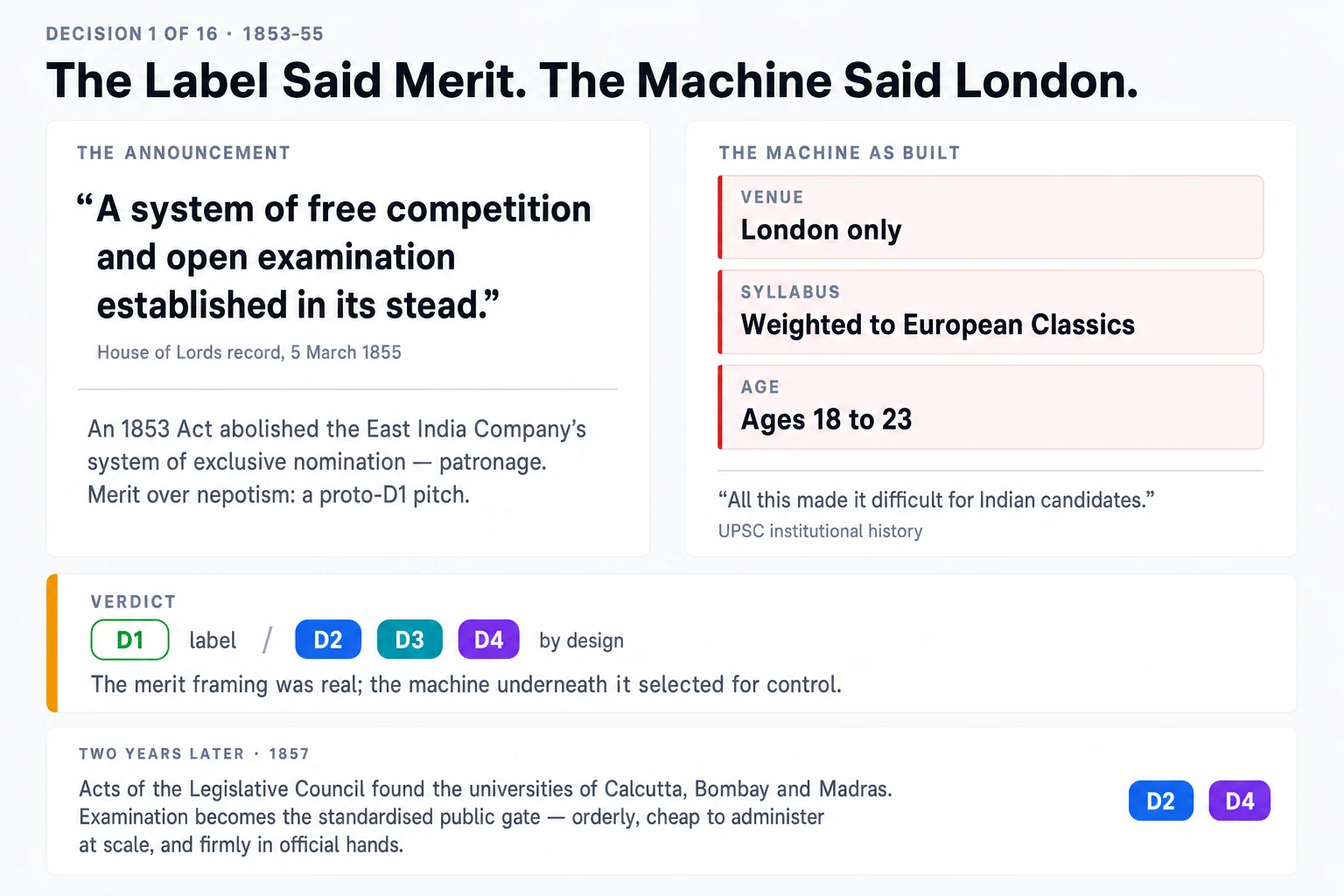
The origin decision was colonial and it was sold as an integrity measure. Under an 1853 Act, the East India Company’s system of “exclusive nomination” — patronage — was abolished and, as the House of Lords recorded on 5 March 1855, “a system of free competition and open examination established in its stead.” Merit over nepotism: a proto-D1 pitch. But look at what was actually built. The Indian Civil Service examination, per the UPSC’s own institutional history, was held only in London, weighted heavily toward European Classics, with a narrow age window — a design that screened for a particular administrative and social fit. The merit framing was real; the machine underneath it selected for control. Two years later, Acts of the Legislative Council founded the universities of Calcutta, Bombay and Madras (all 1857), each “for the purpose of ascertaining, by means of examination, the persons who have acquired proficiency.” Examination became the standardised public gate — orderly, cheap to administer at scale, and firmly in official hands. D2 and D4, from item one.
Fast-forward through the constitutional plumbing. The 42nd Amendment (1976, in force 3 January 1977) moved “medical education” from the State List to the Concurrent List — the structural precondition that let the Centre legislate a national exam at all. A tractability enabler, not an integrity one.
Then the courts spent three decades building the legal scaffolding, mostly around a different problem — capitation fees and private-college profiteering:
- Pradeep Jain (1984) established the all-India merit quota — “at least 30 per cent of the open seats” on merit — framed as national interest, but in the same breath accommodating state and institutional claims. Merit-flavoured D1, with D4 baked in.
- AIPMT (first exam 22 May 1988, ~77,000 registered) was created by CBSE, following a 1987 Supreme Court order, to fill the 15% All-India Quota. Its stated purpose, per CBSE’s own records, was “equitable” central-quota access. That is D3 — about who gets in, not about stopping cheating.
- Unni Krishnan (1993) imposed the 50/50 free-and-payment-seat scheme to “eliminate discretion… at the root of… commercialisation.” D1/D3.
- TMA Pai (2002) overruled that scheme, restoring private-institution autonomy — a D4 accommodation with a merit caveat.
- Islamic Academy (2003) answered with fee-and-admission committees “to ensure… merit is adequately taken care of.” D1/D4.
- P. A. Inamdar (2005) held that a state may run a Common Entrance Test “in the interest of achieving… transparency and merit” — while barring the state from imposing quotas on unaided colleges. This is the doorway NEET later walked through.
Notice the through-line. Across nine decisions and 150 years, the animating problems were tractability (too many exams, too much burden), access (who gets the seats), and institutional interest (who controls admissions and fees). The word that is almost never the design driver — however often it appears in the rhetoric — is anti-cheating integrity.
Around 2010, on the eve of NEET, roughly 35 separate medical entrance exams fed some 412 medical colleges (CBSE ran the 15% central quota; states and private bodies ran the other 85%). That number is a peer-reviewed journal estimate, not an official registry count — treat it as approximate. But approximate or not, it is the mess NEET was pitched to clean up. Which brings us to the gate.
When did one exam become the only gate?
NEET became the constitutionally operative single gate in 2016 and the universal gate in 2020 — but not through one decision. It closed across sixteen of them. Here is the extractable spine: each decision, its stated reason on the record, and the driver it actually served, judged by design and effect.
| # | Decision | Year | Stated reason (on the record) | Revealed driver | Consequence |
|---|---|---|---|---|---|
| 1 | ICS open competition | 1853–55 | Merit over patronage | D1 label / D2–D4 by design | Examination becomes the gate |
| 2 | Presidency universities as exam gate | 1857 | Standardised proficiency | D2 / D4 | Examination institutionalised |
| 3 | 42nd Amendment: medical education → Concurrent List | 1976 | Central legislative competence | D2 structural | Enables a national exam |
| 4 | Pradeep Jain — ≥30% all-India merit quota | 1984 | Merit / national interest | D1-flavoured + D4 accommodation | Judicial origin of the AIQ |
| 5 | AIPMT for the 15% AIQ | 1988 | Equitable central-quota access | D3 | Central-quota exam is born |
| 6 | Unni Krishnan — 50/50 scheme | 1993 | Curb commercialisation | D1 / D3 | Merit-based common exam pushed |
| 7 | TMA Pai | 2002 | Merit + institutional autonomy | D4 accommodation | Unni scheme overruled |
| 8 | Islamic Academy | 2003 | Fee/admission committees, transparency | D1 / D4 | Regulatory machinery |
| 9 | Inamdar — CET permissible | 2005 | Transparency & merit | The door NEET used | Legal basis for a common test |
| 10 | MCI single-NEET notification | 2010 | Uniformity/burden (+ an integrity strand, recorded in litigation) | D2 | “Single” NEET, admission “solely” on marks |
| 11 | CMC Vellore strikes NEET down | 2013 | Authority / federal rights — not integrity | — | NEET quashed as ultra vires |
| 12 | Recall & restoration | 2016 | Procedural revival | D2 mechanical | 2010 notifications revive |
| 13 | NTA created | 2017 | “Reliability, standardised difficulty,” self-sustained | D2 / D4 | New exam agency |
| 14 | NEET stays paper while JEE → CBT | 2018–19 | MoHFW request; four competing grounds | UNSETTLED | The pivotal fork |
| 15 | NMC Act absorbs AIIMS/JIPMER | 2019–20 | MCI “corrupt & ineffective”; access/quality | D2 structural | NEET becomes universal |
| 16 | Public Examinations Act | 2024 | Deter leakers | D1 label — touches no failure surface | Penalties, nothing built |
The mechanics of the gate closing: the MCI gazette notification of 21 December 2010 created a single NEET with admission “based solely on marks obtained.” The Supreme Court struck it down on 18 July 2013 — but read why: the majority held the MCI “not empowered under the 1956 Act,” a ruling about authority and federal rights under Articles 19(1)(g) and 30(1). Integrity was not the question; competence was. On 11 April 2016 that judgment was recalled, and — as the Court noted on 3 May 2016 in Sankalp — “the Notifications dated 21st December, 2010 are in operation as on today.” The restoration was mechanical: the legal bar had lifted, so the exam revived. Not re-justified on fairness; simply switched back on. In 2017 the Court dismissed the Tamil Nadu petitions on a rule-of-law rationale. And the NMC Act, 2019 — through its Section 14 “any other law” proviso — folded even AIIMS and JIPMER into NEET from the 2020 cycle. NEET became the constitutionally operative single gate in 2016, and the universal gate in 2020.
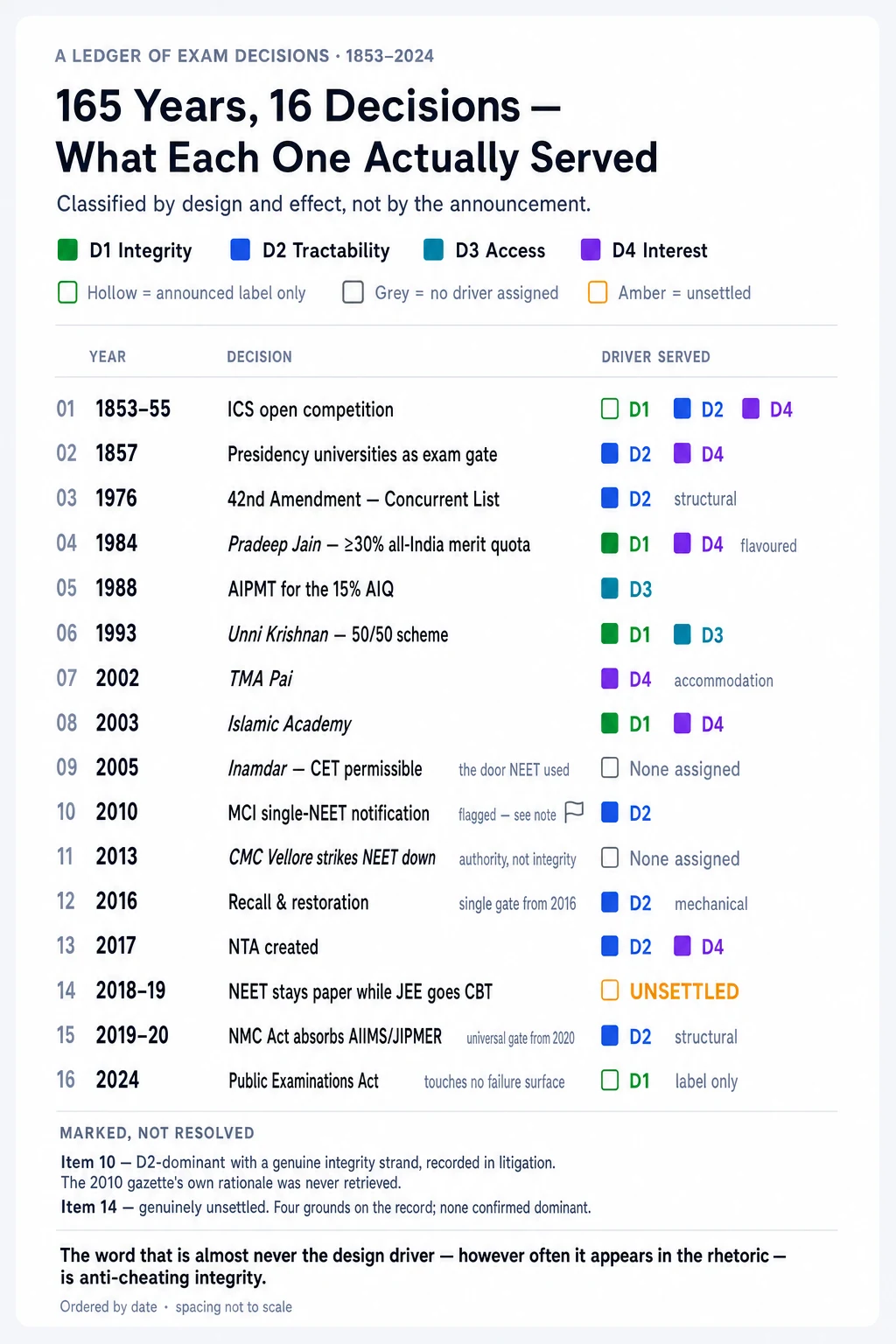
Two entries in that table need to be marked honestly rather than resolved.
Item 10. The verbatim rationale of the 2010 gazette notification was never retrieved for this piece. What we have is the reasoning recorded in the 2013 litigation, and it runs on two strands: the MCI’s counsel argued NEET would end “capitation fee and other malpractices” (an integrity strand), while the Union’s submission and contemporary reporting led with “uniformity of standards” and lessening “the hardship of aspiring students” appearing in multiple exams (tractability). So the honest label is recorded-in-litigation, D2-dominant with a genuine integrity strand — not gazette-verbatim.
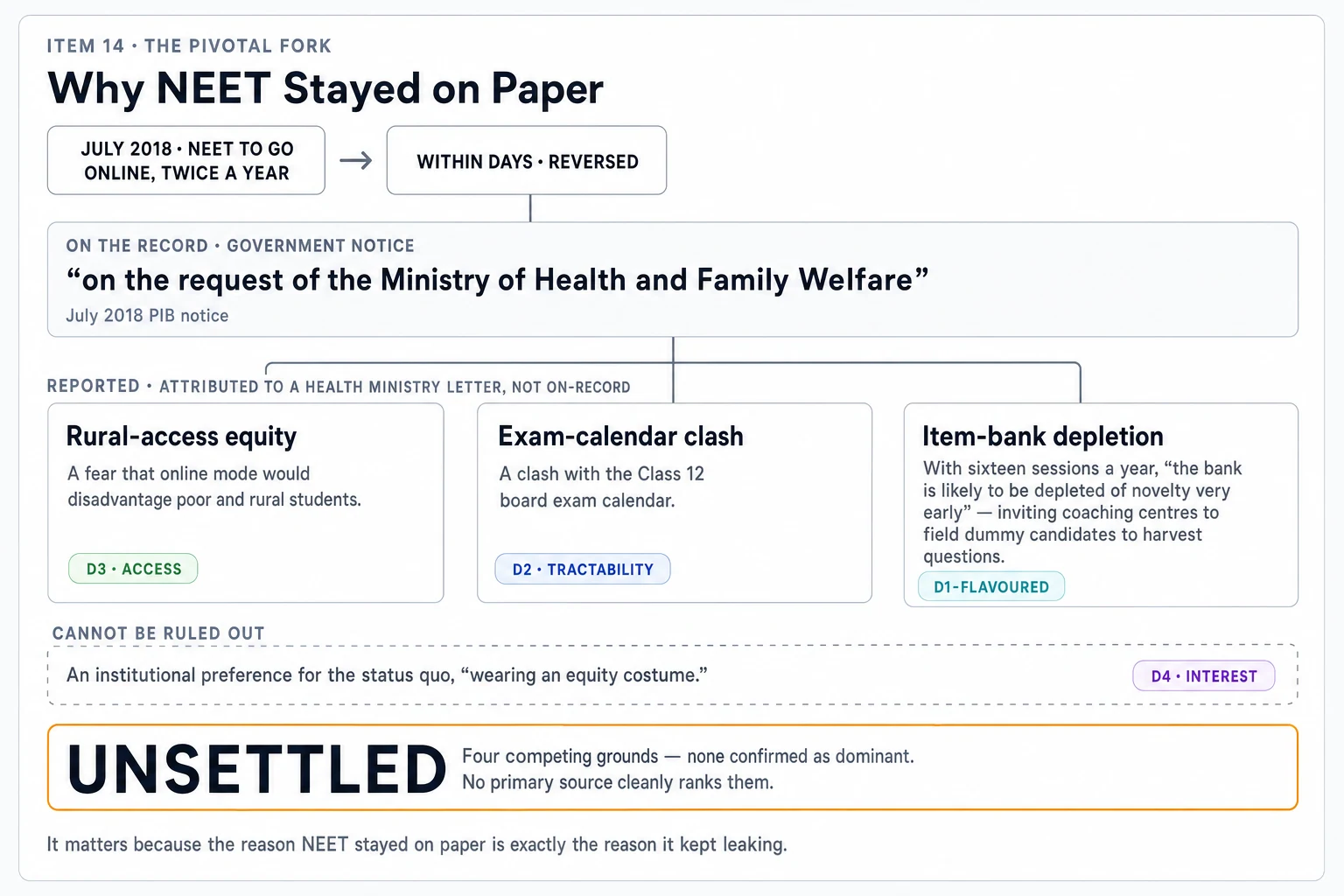
Item 14 is the single most important dig in this whole history, and it is genuinely unsettled. In 2017–18 the government moved JEE Main to computer-based testing, and in July 2018 announced NEET would follow — online, twice a year. Within days the plan for NEET was reversed. Why? The record offers four competing grounds, and no primary source cleanly ranks them. A July 2018 PIB notice states the reversal was “on the request of the Ministry of Health and Family Welfare.” Reporting attributed the Health Ministry’s objections to (a) rural-access equity — a fear that online mode would disadvantage poor and rural students (D3); (b) an exam-calendar clash with Class 12 boards (D2); and — strikingly — (c) an item-bank concern: with sixteen sessions a year “the bank is likely to be depleted of novelty very early,” inviting coaching centres to field dummy candidates to harvest questions (a D1-flavoured worry). We report Item 14 as unsettled, with all four grounds on the record and none confirmed as dominant. It matters because the reason NEET stayed on paper is exactly the reason it kept leaking — and we cannot tell you, from the sources, whether that was a considered integrity judgement or an institutional preference for the status quo wearing an equity costume.
Was any of it built to stop cheating?
On the evidence, no Indian exam reform can be shown to have measurably reduced cheating — and why no one can say so is itself the finding. Here the thesis meets the two decisions that were most explicitly about the exam machinery.
The NTA (2017). Read the Cabinet’s own approval release of 10 November 2017. It creates an “autonomous and self-sustained premier testing organization” that will “bring in high reliability, standardized difficulty level.” It promises a one-time grant of ₹25 crore, “financially self-sustainable” thereafter. What the release does not contain — anywhere — is the language of leak-prevention, custody, or forensic integrity. The founding frame is reliability and self-financing: D2 and D4. (The disconfirming evidence, which you must see: a separate 2018 PIB release, 1538071, did claim NTA’s “highly secured IT software and encryption… will ensure no leakages.” So the integrity claim exists — in a subsidiary release, not the founding Cabinet decision.)
Did the NTA build the D1 capacity its rhetoric implied? A Rajya Sabha standing committee report, presented 8 December 2025, found it had not. The Agency “has not inspired much confidence,” the committee said, and — the number to remember — it was sitting on a ₹448 crore surplus (₹3,512.98 crore collected, ₹3,064.77 crore spent over six years) that it had not deployed to build the capability to run tests itself. Of the 14 exams NTA ran in 2024, at least five had major failures, NEET-UG among them. The clincher for our thesis surfaced only on 25 July 2026: NTA finally advertised for “Assessment Research and Development and Psychometrics” experts to “build and curate NTA’s secure item banks.” Eight years after its founding, the in-house psychometric and item-bank capacity — the core of D1 — was still being recruited.
The Public Examinations (Prevention of Unfair Means) Act, 2024. This is the cleanest test in the ledger, because we have the full statutory text. Enacted 12 February 2024, in force 21 June 2024, it defines fifteen categories of “unfair means” and prescribes penalties: three-to-five years’ imprisonment and up to ₹10 lakh for individuals; up to ₹1 crore for service providers; five-to-ten years and a minimum ₹1 crore fine for “organised crime.” Read the whole Act and here is what you will not find: a single provision on custody protocols, item-bank capacity, question-paper-setting architecture, or exam-delivery security. Its Statement of Objects and Reasons is explicit — the aim is “effectively and legally deterring persons… for monetary or wrongful gains.” It is, end to end, a penal instrument. An integrity label; zero investment in the integrity surface. The textbook D2/D4-in-D1-clothing.
Which sets up the question that should stop you cold. Has any Indian exam reform ever measurably reduced cheating?
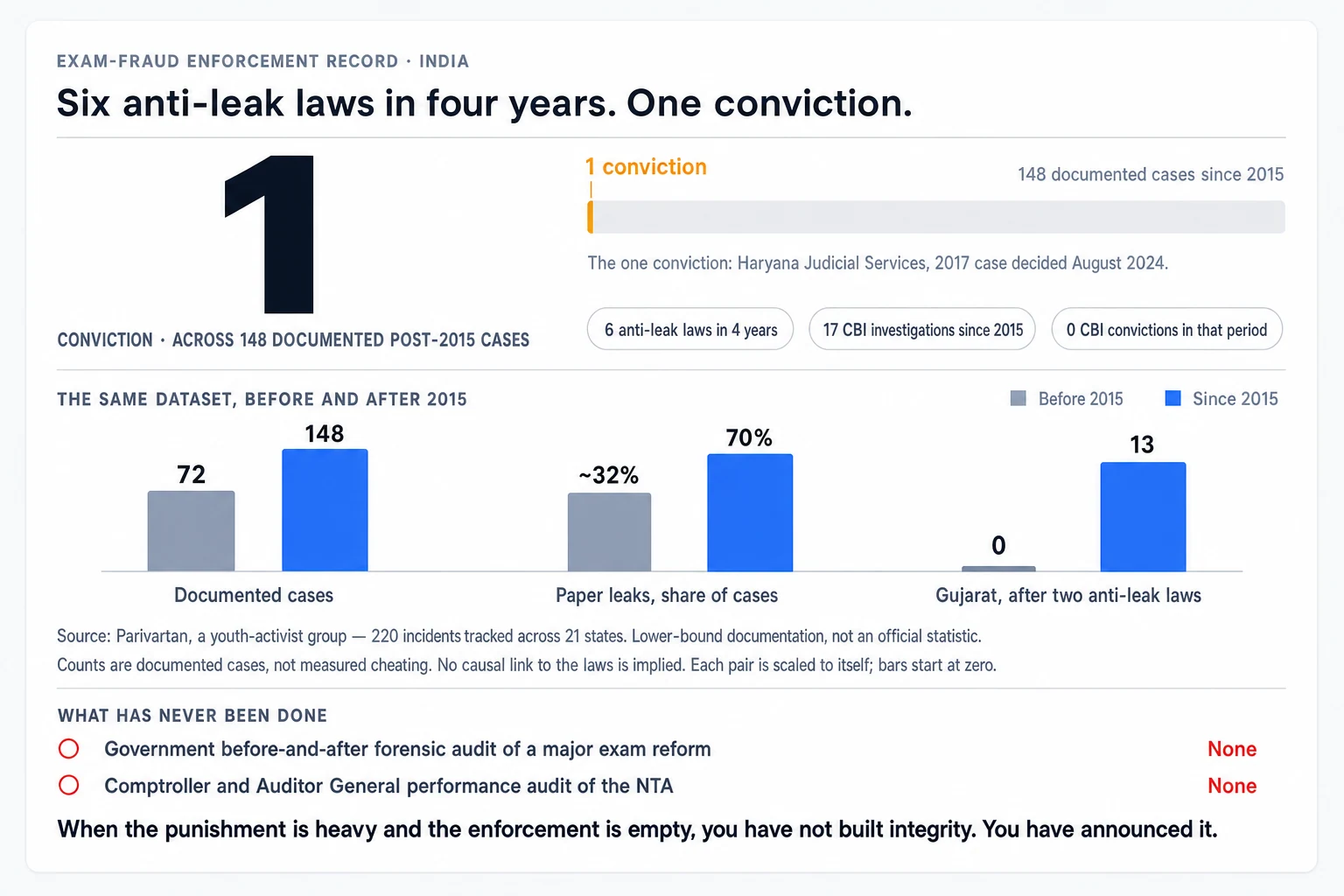
The honest answer is that no one can say it has — and why no one can say it is itself the finding. There has never been a government before-and-after forensic audit of a major exam reform, and the Comptroller and Auditor General has never performed a performance audit of the NTA. The state has simply never instrumented the question.
The only before/after dataset anyone has assembled points the wrong way. It comes from Parivartan, a youth-activist group — so read it as lower-bound documentation, not an official statistic. Their tracking of 220 incidents across 21 states found that documented cases roughly doubled after 2015 (72 before, 148 after); paper leaks rose from about 32% to 70% of cases; Gujarat, which passed two successive anti-leak laws, went from zero documented cases to thirteen, its worst years arriving after the laws. And the number that should be printed on every reform press release:
Across 148 documented post-2015 cases, India’s courts have produced exactly one conviction.
Six anti-leak laws in four years, the most intensive legislative response in the country’s history. One conviction. When the punishment is heavy and the enforcement is empty, you have not built integrity. You have announced it. That is the pattern the ledger keeps repeating — and it is why the honest verdict on the thesis is upheld, but not absolute: fairness was seldom the thing being built, though the record carries real integrity strands (2010, the 2018 “no leakages” release) that keep it from being a clean sweep.
What did the Rajan and Radhakrishnan reports actually find?
Two official reports let you check the thesis against data rather than rhetoric: the Rajan Committee measured who NEET advantages (a documented D3 shift), and the Radhakrishnan Committee shows the D1-versus-D2 split in the most recent pre-2026 reform.
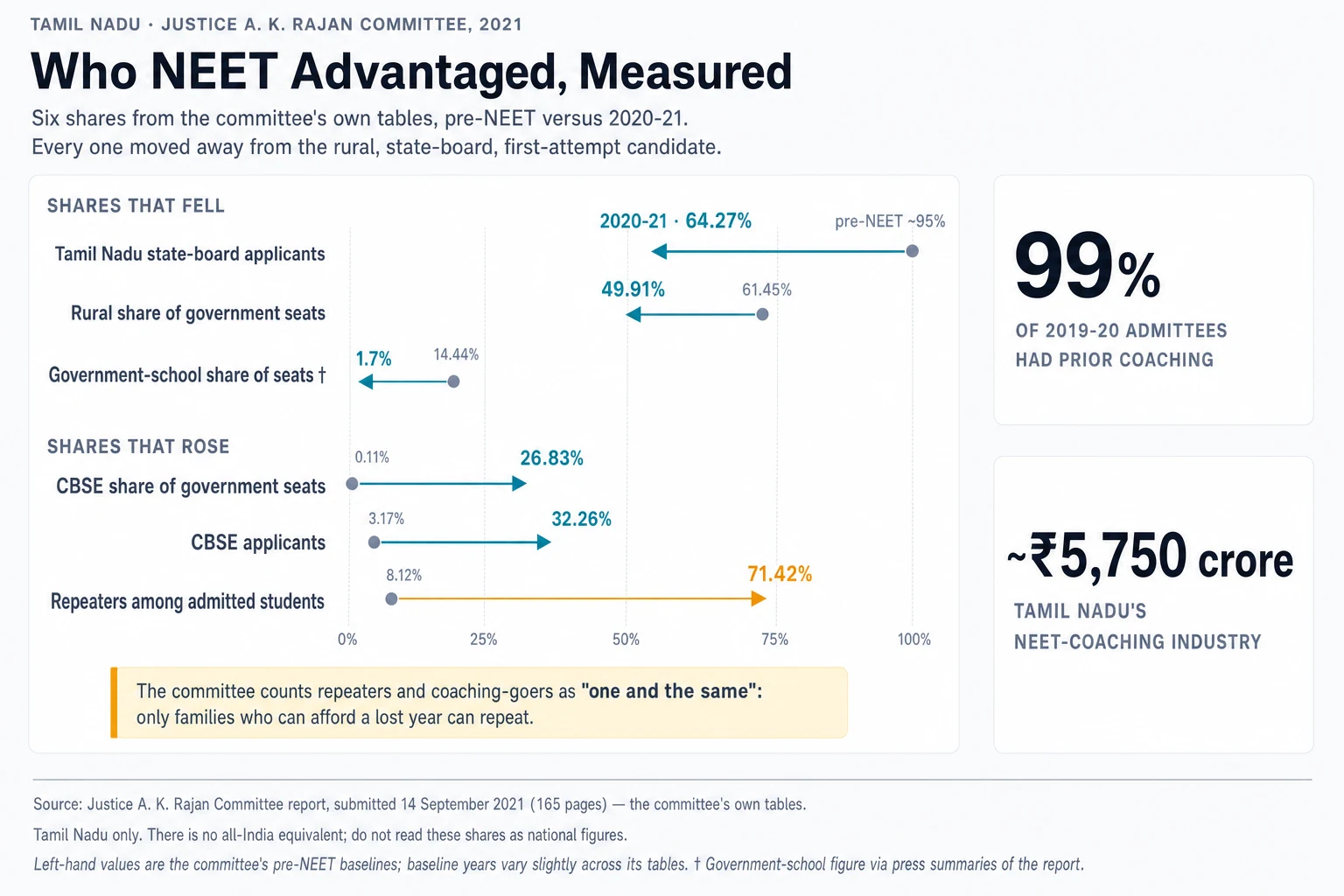
The Justice A. K. Rajan Committee (Tamil Nadu, report submitted 14 September 2021, 165 pages). Its purpose was to measure who NEET advantages — and the answer, from the committee’s own tables, is documented, not political noise. But it is Tamil-Nadu-specific; there is no all-India equivalent, and generalising it nationally would overreach. Within that scope:
- Rural students’ share of government medical-college admissions fell from a pre-NEET average of 61.45% to 49.91% (2020-21).
- Tamil Nadu state-board applicants fell from roughly 95% to 64.27%, while CBSE applicants rose from 3.17% to 32.26%.
- CBSE students’ share of government seats rose from a negligible 0.11% to 26.83%.
- Repeaters rose from 8.12% to 71.42% — and by the committee’s own definition, repeaters and coaching-goers are “one and the same,” because only families who can afford to sit out a year and pay for coaching can repeat.
- 99% of 2019-20 admittees had prior coaching; the committee valued Tamil Nadu’s NEET-coaching industry at about ₹5,750 crore.
That is a real, measured D3 effect: the exam shifted advantage toward the urban, CBSE-schooled, English-medium, coached, and repeat candidate. For an aspirant from a rural state board, the question “was this ever winnable for someone like me?” has a documented answer, at least in one state, and it is not reassuring.
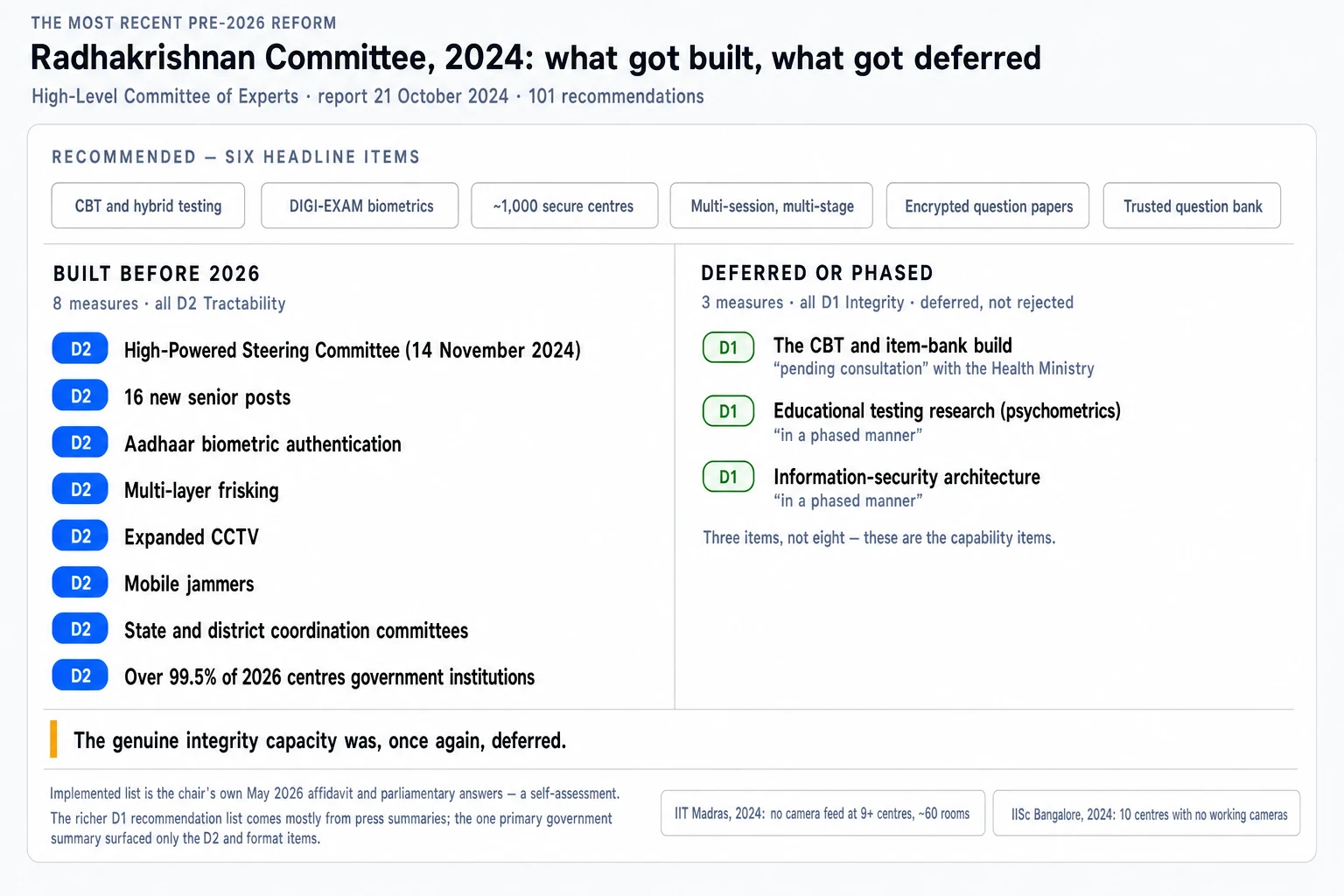
The Radhakrishnan Committee (the High-Level Committee of Experts, report 21 October 2024, 101 recommendations). This is the most recent pre-2026 reform, so it is the fairest test of the deferred-D1 pattern. What did it recommend, and what actually got done before the 2026 cycle?
Recommended: a transition to computer-based and hybrid testing, a “DIGI-EXAM” biometric system, roughly 1,000 secure standard testing centres, multi-session and multi-stage testing, encrypted question papers, and — the phrase that matters — a “trusted question bank.”
Implemented before 2026 (per the chair’s own May 2026 affidavit and parliamentary answers): a High-Powered Steering Committee (14 November 2024), 16 new senior posts, Aadhaar biometric authentication, multi-layer frisking, expanded CCTV, mobile jammers, state- and district-level coordination committees, and a policy that over 99.5% of 2026 centres be government institutions.
Look at the split. Everything implemented is D2 — coordination, staffing, frisking, cameras, centre policy. The D1 items — the actual CBT-and-item-bank build, the “educational testing research” (psychometrics), the information-security architecture — were, in the chair’s own words, “pending consultation” with the Health Ministry or being implemented “in a phased manner.” The genuine integrity capacity was, once again, deferred. (One caveat for the sceptic: the richer D1-flavoured recommendation list comes mostly from press summaries; the one primary government summary that surfaced surfaced only the D2/format items. And independent monitors — IIT Madras, IISc Bangalore — found even the D2 measures, like working CCTV, patchy in 2024.)
Where does cheating really enter the system?
Cheating enters through exactly two surfaces, and a screen closes neither: the physical chain of custody, and the economics of a scarce, high-value seat. This is the part that dissolves the “will digital fix it?” question — not by arguing, but by showing you where compromise physically enters.
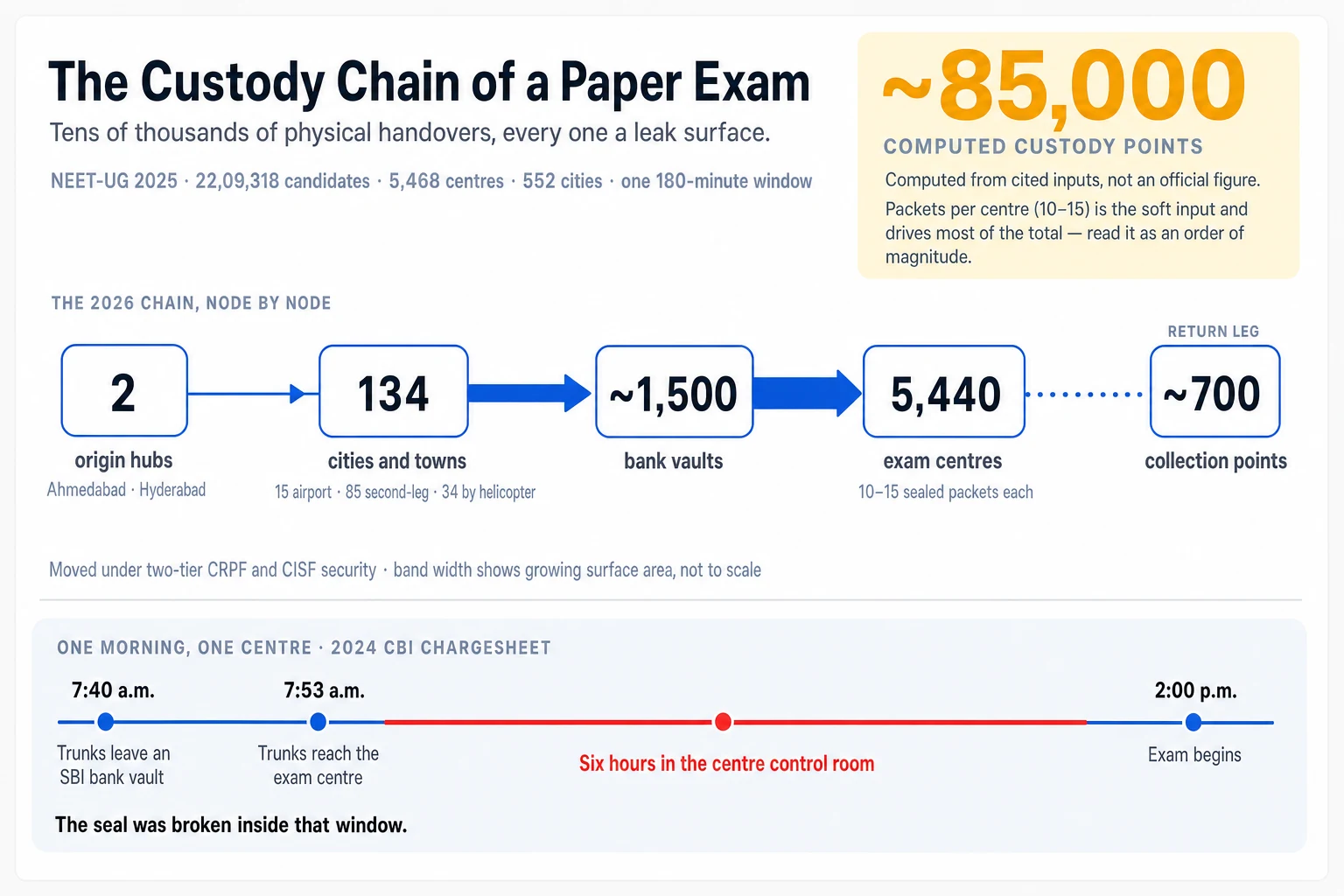
Surface one: the custody chain. Picture what a single-day, single-shift paper exam at ~22 lakh candidates actually is, physically. In 2025, NEET-UG ran for 22,09,318 candidates across 5,468 centres in 552 cities, in one 180-minute window. Every one of those papers has to be printed, sealed, flown, stored, guarded, handed over, opened, and — afterwards — collected and returned. Each handover is a point where a human being touches a sealed packet. Count them.
From the sources, the 2026 chain ran: 2 origin hubs → a distribution network reaching well over 100 cities → roughly 1,500 bank branches as intermediate vaults → 5,440 centres → some 700 post-exam collection points. Multiply the centre count by the packets each centre holds (reporting suggests 10–15 per centre) and add the nodes, and you get a computed total of roughly 85,000 distinct custody points.
That 85,000 is computed from cited inputs, not an official figure — and the packets-per-centre multiplier is the soft part, driving most of the total, so treat it as an order-of-magnitude estimate. But the order of magnitude is the point. Tens of thousands of physical handovers, every one a leak surface. And the 2024 Hazaribagh leak entered exactly there: a CBI chargesheet describes two trunks collected from an SBI bank vault at 7:40 a.m., delivered to a centre by 7:53, and sitting in a control room for six hours before the exam — a window in which the seal was broken. The leak did not come through the paper format. It came through the custody chain that a paper format requires.
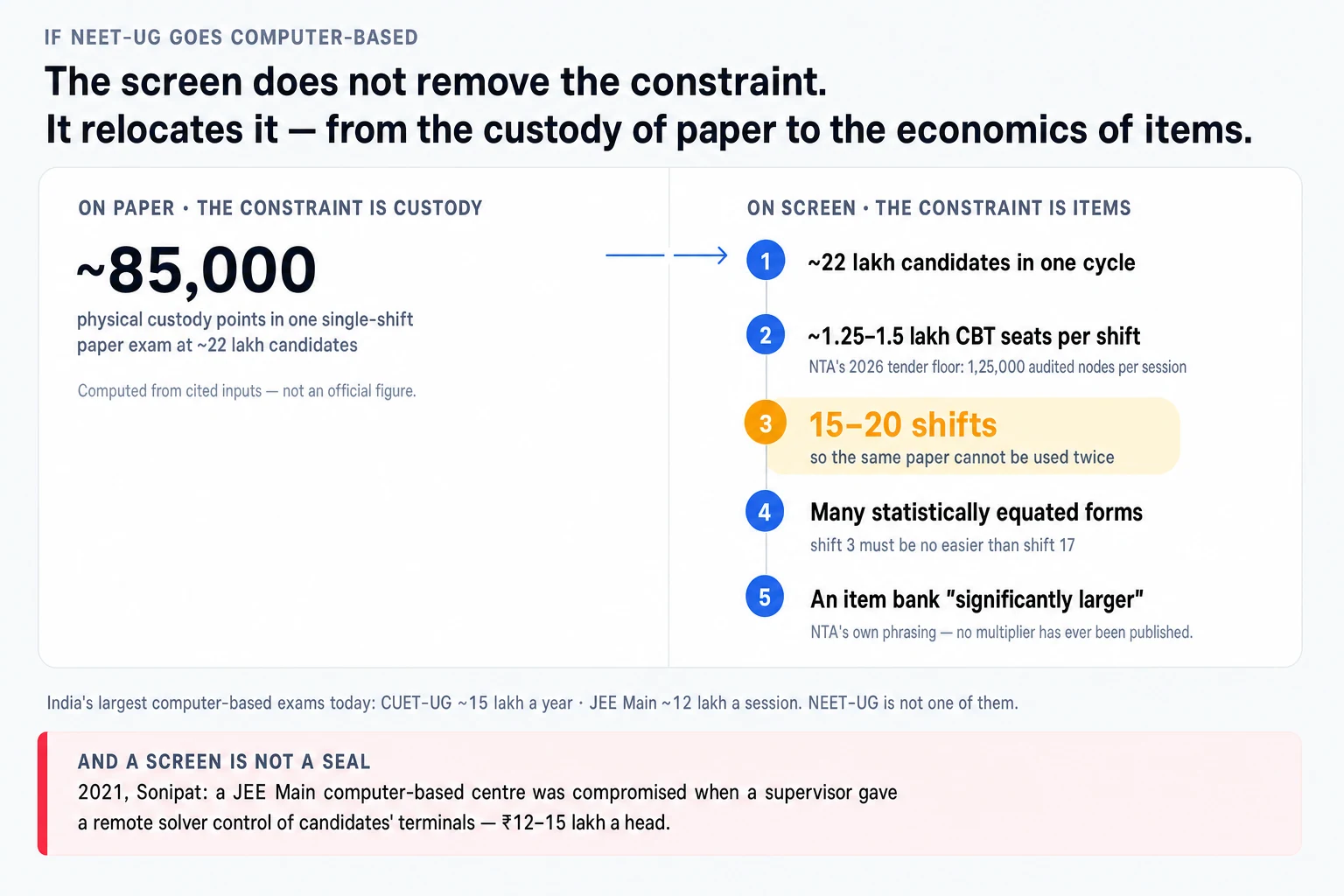
Now the obvious rejoinder: so go digital and the trunks disappear. Watch what actually happens to the arithmetic. India’s current CBT infrastructure seats roughly 1.25 to 1.5 lakh candidates per shift (NTA’s own 2026 tender sets a floor of 1,25,000 audited nodes per session). To put 22 lakh candidates through at that capacity requires fifteen to twenty shifts — which means the same paper cannot be used twice. You now need many different-but-equivalent question sets, statistically equated so that a candidate in shift 3 is neither advantaged nor penalised versus shift 17. And equated multi-session testing demands an item bank “significantly larger” (NTA’s phrasing; no one has published a multiplier) than anything India has built. The screen does not remove the constraint. It relocates it — from the custody of paper to the economics of items. And it is not leak-proof: in 2021, the JEE Main CBT was compromised at a Sonipat centre when a supervisor granted a remote-access solver control of candidates’ terminals, at ₹12–15 lakh a head. Computer-based, and still breached.
Surface two: item economics — which is really seat economics. This is the surface most people never name, and it is the one that predicts fraud. Vyapam is the anchor. In the Madhya Pradesh scandal, the Supreme Court (in Nidhi Kaim) confirmed the manipulation of admissions for at least 634 candidates between 2008 and 2012, cancelling 634 MBBS admissions in 2017; the BBC and court records document seats “sold to the highest bidder” for between ₹10 lakh and ₹70 lakh. Impersonators, seat-blocking, rigged OMR sheets, computer-falsified seating plans — an entire industrial machine. That machine did not exist because the exam was on paper. It existed because a medical seat is worth a fortune.
Run the maths, as the education analyst Maheshwer Peri did in 2026. About 22 lakh candidates compete for roughly 35,000 open-category government MBBS seats (of ~63,000 government seats within a 2026-27 total of 1,36,939, excluding the Institutes of National Importance). A government seat costs about ₹5 lakh over five years; the private-college alternative runs to ₹1.5 crore. So the incentive to cheat, for a family that cannot pay the private fee, is on the order of ₹1.45 crore. As Peri puts it: “The greater the incentive, the greater the effort that goes into the organised cheating. It is that straightforward.”
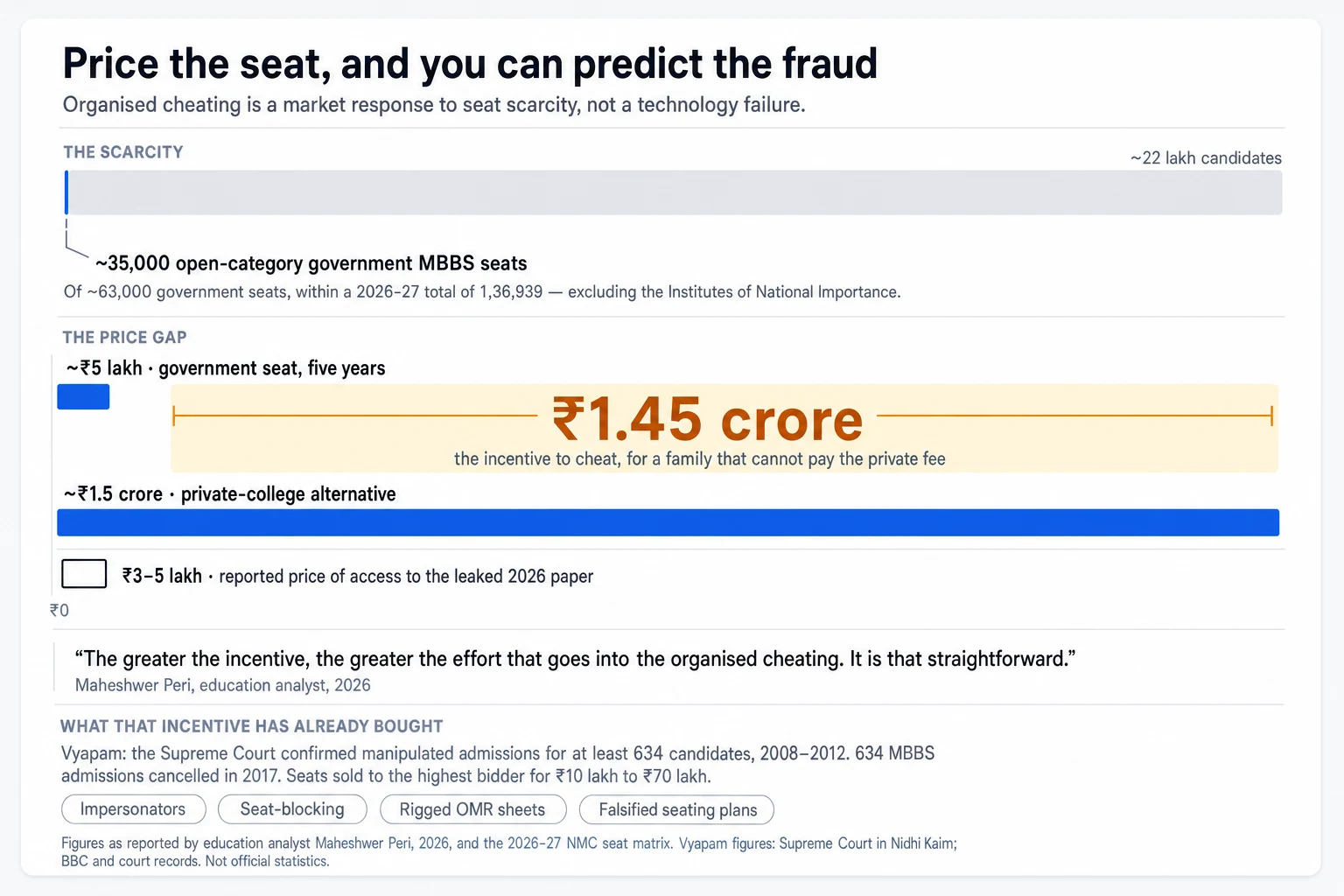
This is the sentence to carry out the door: organised cheating is a market response to seat scarcity, not a technology failure. Price the seat, and you can predict the fraud. A reform that changes the delivery format but leaves a ₹1.45 crore incentive untouched has aimed at the wrong surface.
How did Nigeria and Brazil handle our scale?
Both ran fair exams at or above India’s scale — proving “too big” is false — but through different levers, and neither leaned on the screen alone. Carried to outcomes, not intentions, here is what they show.
| Country (exam) | Candidates (year) | Format choice | What they fixed | Measured outcome | Residual failure mode |
|---|---|---|---|---|---|
| Brazil (ENEM) | ~8.7M registered (2014) | Paper + custody redesign | The chain of custody, after the 2009 leak | Integrity held on paper; only quality-control residuals | Printing/QC errors, not custody breach |
| Nigeria (JAMB/UTME) | ~2.24M registered (2026) | Full CBT since 2015 (~1.47M) + national ID | Identity + item-bank automation | Fraud fell but shifted form to in-centre collusion | Institutional collusion; rural CBT-exposure gap |
Brazil is the counterfactual that kills the CBT assumption. In 2009, ENEM was leaked before the exam — a man offered both booklets to a newspaper for R$500,000 — and the government cancelled it for some 4.1 million candidates. Brazil’s response was not to digitise. INEP’s own 2009 management report attributes the breach to the printer (“Gráfica Plural”), and the fix was custody, not format: papers were thereafter individually wrapped, sealed into locked containers (“CDL”), stored in 63 Army barracks and 624 Correios (postal) branches instead of in the homes of private contractors, and moved under military or highway-police escort — leaving those facilities only on exam day. IRT scoring came in the same year; the unified admissions system, SISU, was created in 2009 (not 2010, a common error). And it held. Since the custody redesign, ENEM’s failures at ~8-million scale have been quality-control residuals, not breaches: a 2010 printing error affecting 0.003% of booklets, a 2019 scoring inconsistency affecting 0.15% (5,974 of ~3.9 million). Integrity, on paper, at eight million. (Two honesty flags for the sceptic: the 2014 registration figure conflicts — 8,721,946 per Agência Brasil/INEP versus 9,519,827 per the Education Ministry, so read “~8.7 million”; and the operational scale is dated — INEP reports ~10,000 sites and 300,000+ collaborators for 2024, not the round “15,000 sites / 70,000 staff” that circulates.)
Nigeria is the honest version of the digital dream. JAMB piloted CBT in 2013 (with about 617 candidates in the 2014 practice run), went fully computer-based on 9 March 2015 (~1.47 million candidates), and by 2026 registered ~2,243,816 — larger than any single Indian CBT exam today. So CBT-at-scale is unquestionably achievable. But did it defeat fraud? Here you must be careful, because the headline everyone quotes — malpractice dropping from “over 4,000 to about 40” — is a 2020-to-2021 year-over-year figure the registrar credits to the National Identification Number requirement, not to CBT (CBT had been mandatory for five years by then). And fraud did not vanish; it shifted form. The registrar himself described the residual cases as in-centre impersonation — security agents swapping candidates after biometric verification. JAMB withheld 76,923 results for irregularities in 2019; detected 178 malpractice cases across 2022–23, about half traceable to institutions. The item bank is sustained through automated authoring (the RAMS system; JAMB self-reports “millions of test items annually,” and an academic study counts “>1,000 items in each of 25 subjects” — both unaudited). And the access gap is real: in one 2021 Osun-state study, 39% of rural-public students had never taken a computer-based test before UTME, though the divide there is more public-versus-private than rural-versus-urban.
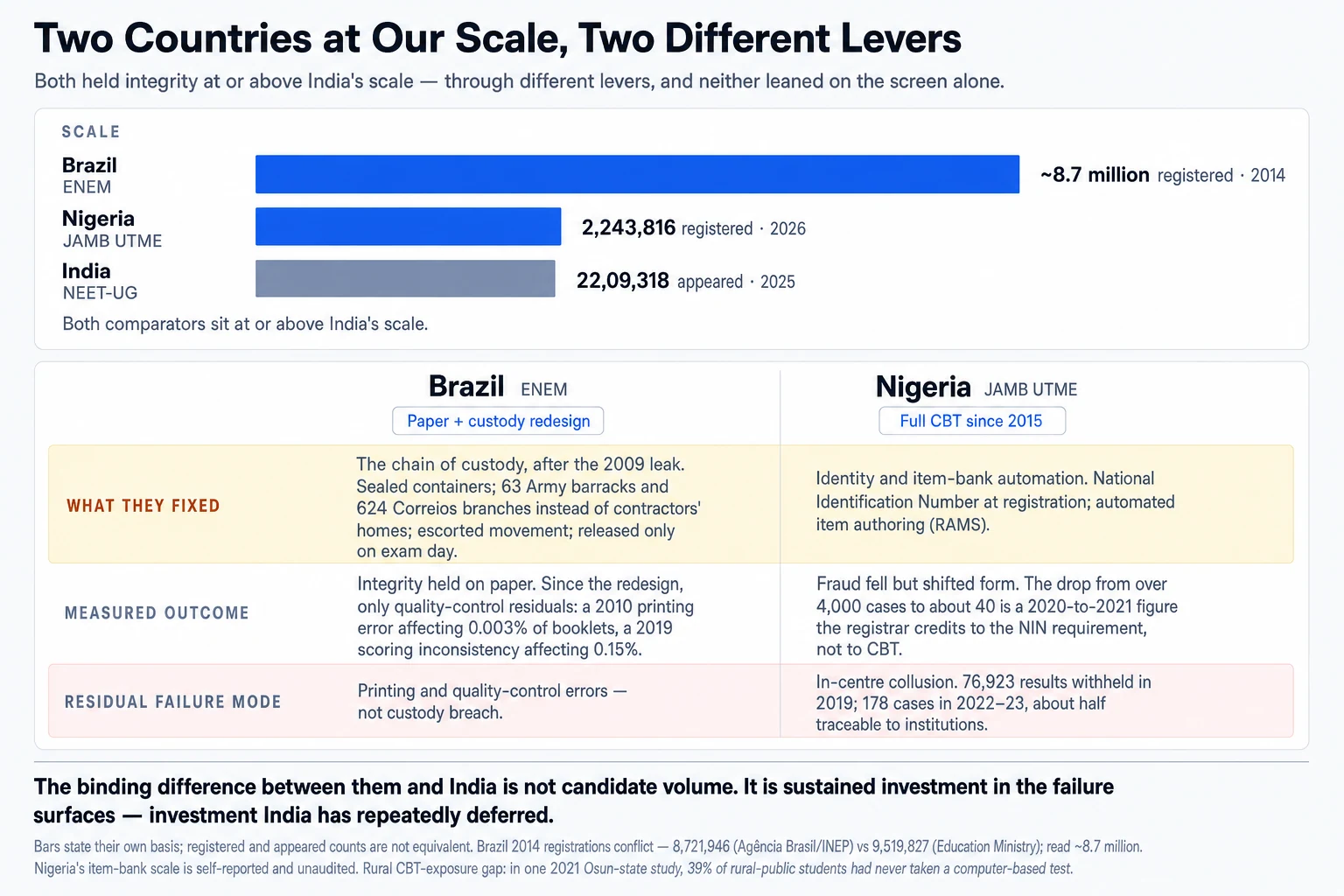
Do not miss the shape of this. The two countries at our scale held integrity through different levers — Brazil through custody, Nigeria through identity plus an item bank — and neither leaned on the screen alone. (China runs the gaokao for ~13.35 million on secured paper; South Korea mobilises the nation, halting aircraft takeoffs, for ~554,000 Suneung candidates; the GRE, GMAT and USMLE run continuously precisely because their item pools and exposure controls let them.) The binding difference between them and India is not candidate volume. It is sustained investment in the failure surfaces — investment India has repeatedly deferred. The fear that we are “too big” does not survive contact with the evidence.
Why doesn’t the SAT leak the way NEET does?
Because leaking the SAT is unprofitable, not because it is uncheatable — a matter of item economics, not the screen. This comparator isolates the point cleanly, and telling it honestly is the test of whether the whole argument is trustworthy.
The College Board’s own Digital SAT Technical Manual (2024) describes the model: operational item pools so large that “each student… is administered a highly comparable but unique test form”; a maximum targeted exposure of 5% for any child item; automated item generation producing interchangeable variants; and one item shown on screen at a time. The consequence, in the manual’s words: “the relative value to bad actors of any leaked content is substantially reduced relative to breaches involving the theft or duplication of entire paper test booklets.” A leaked SAT item is low-value and disposable — retire it, the pool barely notices. A leaked NEET paper is the whole exam, worth crores. That is the difference — item economics, not the screen.
And now the counter-evidence, reported with equal candour, because a piece that only told you the SAT’s success would be selling you something. The SAT has failed, repeatedly. Reuters documented at least eight occasions since late 2013 on which SAT material circulated online before overseas administrations, and an internal presentation showing that nine of the eighteen forms in the College Board’s June 2013 inventory were “compromised.” The Board cancelled sittings in South Korea (2013) and China/Macau (2016); a 2016 breach exposed hundreds of unpublished items. In the digital era, the New York Times (January 2026) documented question markets on Telegram, Scribd, and a site called bluebook.plus — 875,000 visitors in a single month — plus hardware and software used to capture and relay screens. (Note carefully: the widely-quoted “fraction of 1%” affected-scores figure and the “several hundred thousand” item-pool figure are College Board press statements relayed through the NYT — not claims in the Technical Manual. Attribute them accordingly.)
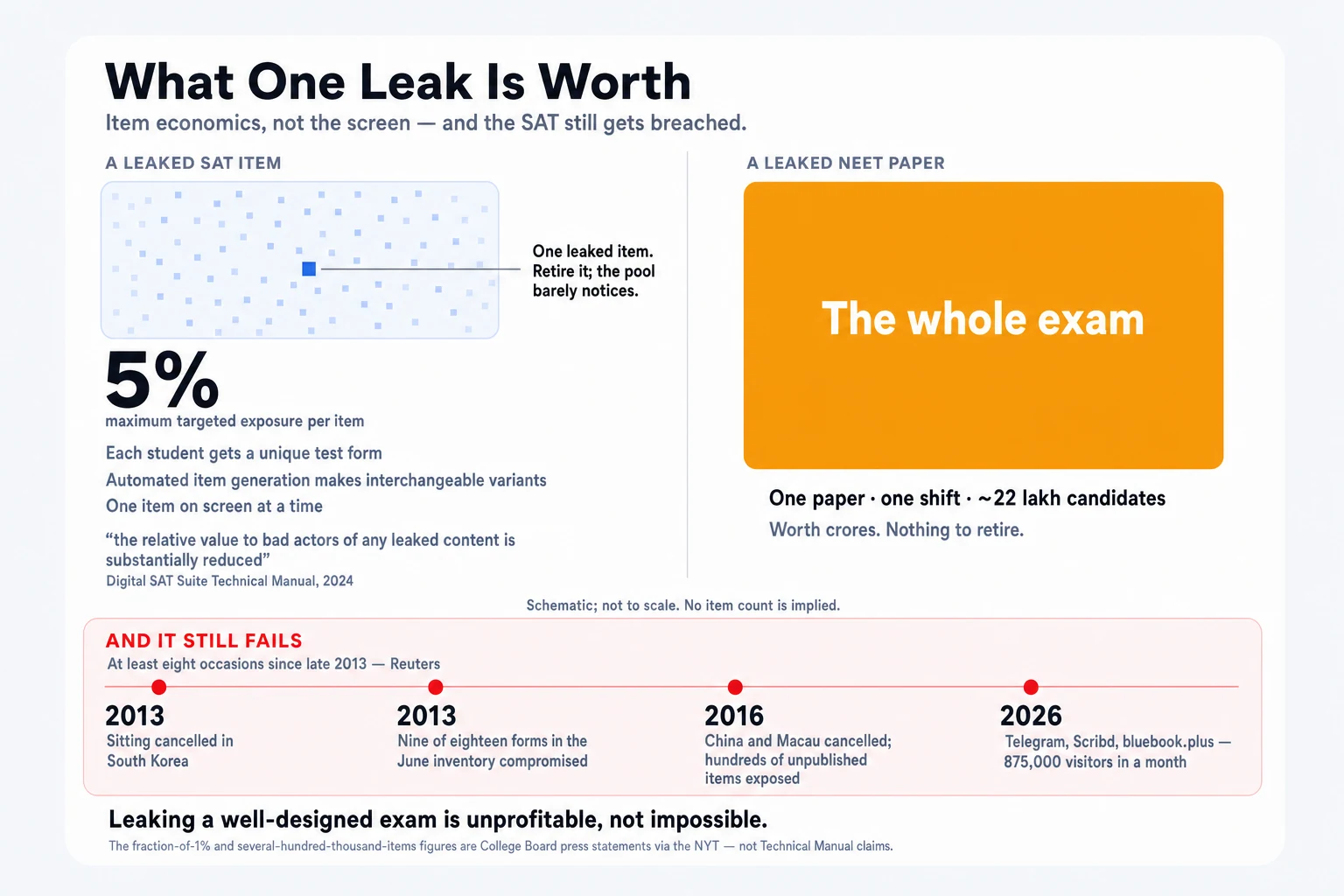
The lesson for anyone tempted to think CBT alone is the cure: leaking a well-designed exam is unprofitable, not impossible. Unprofitability is an item-economics achievement, and item economics is a D1 investment India has not yet made.
What would prove 2026 is different?
One checkable thing: a published Terms of Reference (or NTA mandate) that funds a continuous item-bank and psychometric capability — the D1 surface — rather than another format-and-penalty announcement. This is not a prediction of what the Nilekani task force will recommend. It is a way to classify whatever it does — the way a surgeon runs a checklist, not to be clever but to catch the specific failure that competent people keep making.
Concretely, the checkable signals — drawn from what assessment standards (AERA/APA/NCME) and an ex-NTA research adviser actually specify:
- 1. A funded, continuous item-bank and psychometric mandate. Not a one-time procurement, not a vendor requirement — a standing in-house capability to build, calibrate, and rotate items. (The single most watchable early signal already exists: NTA’s 25 July 2026 advertisement for psychometrics and item-bank experts. Watch whether it becomes a department or evaporates.)
- 2. Independent psychometric review, with validity and reliability evidence made public. If nobody outside the agency can check the exam’s measurement quality, it is not being built for integrity.
- 3. A computer-adaptive or multi-session pilot before national rollout — because that is the only honest way to prove the item bank is deep enough to survive equating at 22-lakh scale.
- 4. An explicit custody redesign — the Brazil lesson — not just cameras and jammers, which are D2 dressing on the same chain.
And the failing grade: a bare announcement of computer-based testing plus stiffer criminal penalties, with nothing funded on the four points above. That is Item 16 and the NTA founding all over again — an integrity label on a tractability build.
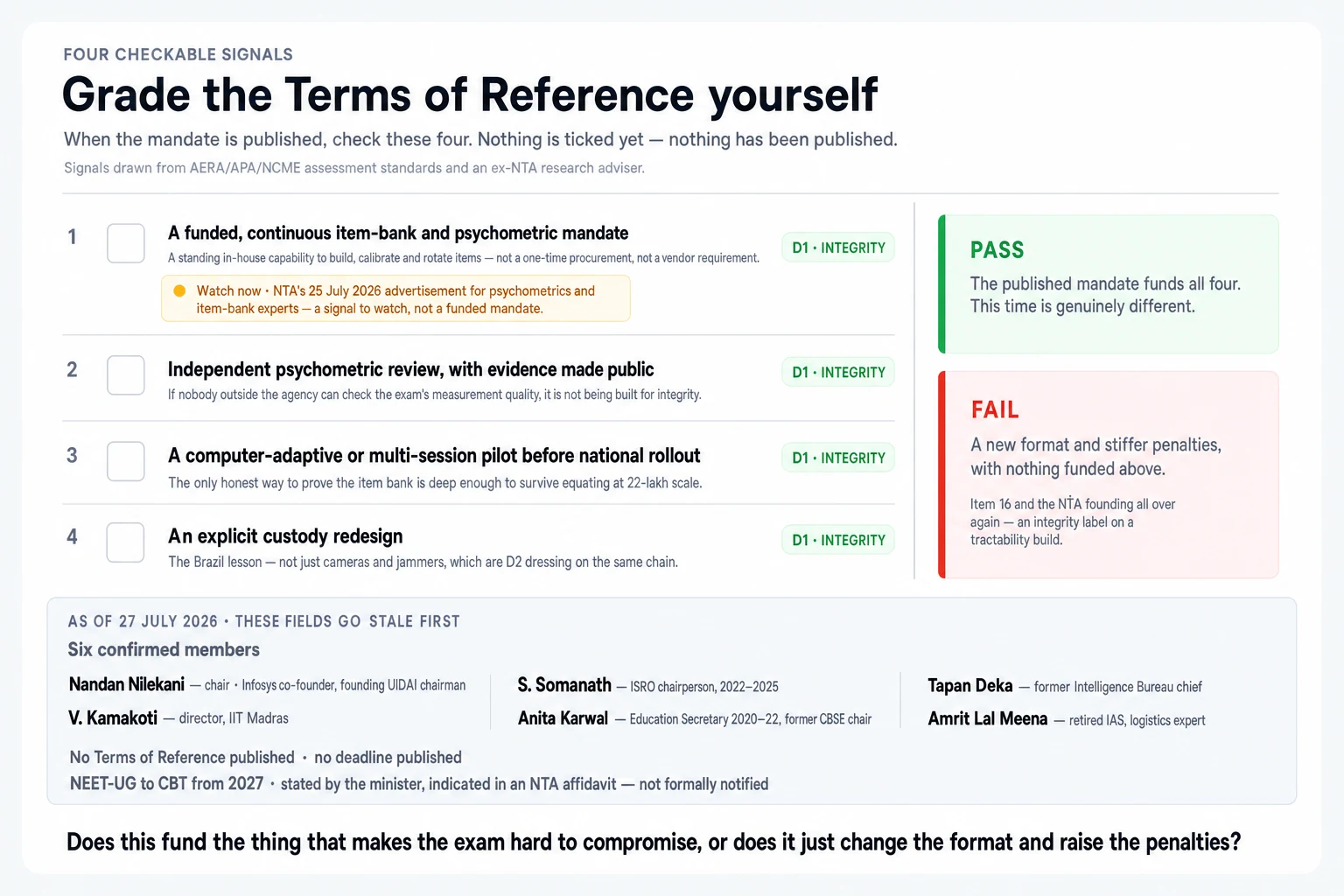
Where things stand as of 27 July 2026 — and these are the fields that will go stale first, so check them: the task force has six confirmed members (Nilekani as chair, alongside S. Somanath, Tapan Deka, V. Kamakoti, Anita Karwal, and Amrit Lal Meena); no Terms of Reference and no deadline have been published; and the shift of NEET-UG to CBT from 2027, while stated by the minister and indicated in an NTA affidavit to the Supreme Court, has not been formally notified.
The father in Nagpur does not need anyone to tell him what the task force will decide. He needs the ledger — and now he has it. When the Terms of Reference are published, he can read them himself and ask the only question that has ever mattered: does this fund the thing that makes the exam hard to compromise, or does it just change the format and raise the penalties? If the answer is the former, this time is genuinely different. If it is the latter, it is the 165-year pattern, one more time.
That is not a comforting place to end. But it is an honest one, and it hands you the one thing two years of being told you were collateral damage never did: the ability to judge for yourself.
FAQ
A patchwork. By 2010, roughly 35 separate medical entrance exams fed some 412 colleges — CBSE ran the 15% All-India Quota through AIPMT (first held 22 May 1988), while states and private bodies ran the other 85%. Underneath sat a century of exam machinery inherited from colonial rule (the 1853–55 ICS competition; the 1857 Presidency universities) and three decades of Supreme Court rulings — Pradeep Jain (1984), Unni Krishnan (1993), TMA Pai (2002), Islamic Academy (2003), Inamdar (2005) — mostly about private-college fees, not cheating.
NEET was created by an MCI gazette notification on 21 December 2010, struck down by the Supreme Court on 18 July 2013 (for lack of MCI authority, not on integrity grounds), and restored when that judgment was recalled on 11 April 2016 — making it the constitutionally operative single gate from 2016. The NMC Act, 2019 folded even AIIMS and JIPMER into NEET from the 2020 cycle, making it the universal gate.
On the record, no — not primarily. Judged by design and effect across 16 decisions, the drivers were mostly administrative tractability and institutional interest, with real but secondary integrity strands. The 2017 NTA founding release spoke of “reliability” and being “self-sustained,” not leak-prevention; the Public Examinations Act, 2024 added heavy penalties but no provision on custody, item banks, or delivery security.
No one can say it has — and that is the finding. There has been no government before-and-after forensic audit and no CAG performance audit of the NTA. The one independent dataset (Parivartan, a youth-activist group) points the other way: documented cases roughly doubled after 2015, and across 148 post-2015 cases India’s courts have produced exactly one conviction.
Not on its own. CBT removes the paper trunks but relocates the constraint to item economics: putting 22 lakh candidates through at ~1.25–1.5 lakh seats per shift needs 15–20 shifts, which needs many equated forms — and therefore a far larger item bank than India has built. Nigeria went fully CBT in 2015 and fraud shifted to in-centre collusion rather than vanishing; the JEE Main CBT was breached at Sonipat in 2021.
Because leaking it is unprofitable, not impossible. Large item pools, a targeted 5% maximum exposure per item, automated item generation, and one item on screen at a time mean a leaked SAT item is low-value and disposable. A leaked NEET paper is the whole exam, worth crores. (The SAT has still been breached — overseas cancellations in 2013 and 2016, and Telegram/hardware markets documented in 2026.)
As of 27 July 2026 the task force has six confirmed members — Nandan Nilekani (chair), S. Somanath, Tapan Deka, V. Kamakoti, Anita Karwal, and Amrit Lal Meena — with no Terms of Reference or deadline yet published. The test: does its published mandate fund a continuous item-bank and psychometric capability, independent psychometric review, a multi-session pilot before rollout, and a custody redesign (D1) — or merely announce a new format and stiffer penalties (D2/D4)?
Last updated: 27 July 2026. Live fields — the task force’s Terms of Reference, any CBT notification, and NEET candidate and centre counts — are re-checked each cycle.